Super globe 2023

Or: Why I put my PhD on hold for 6 months

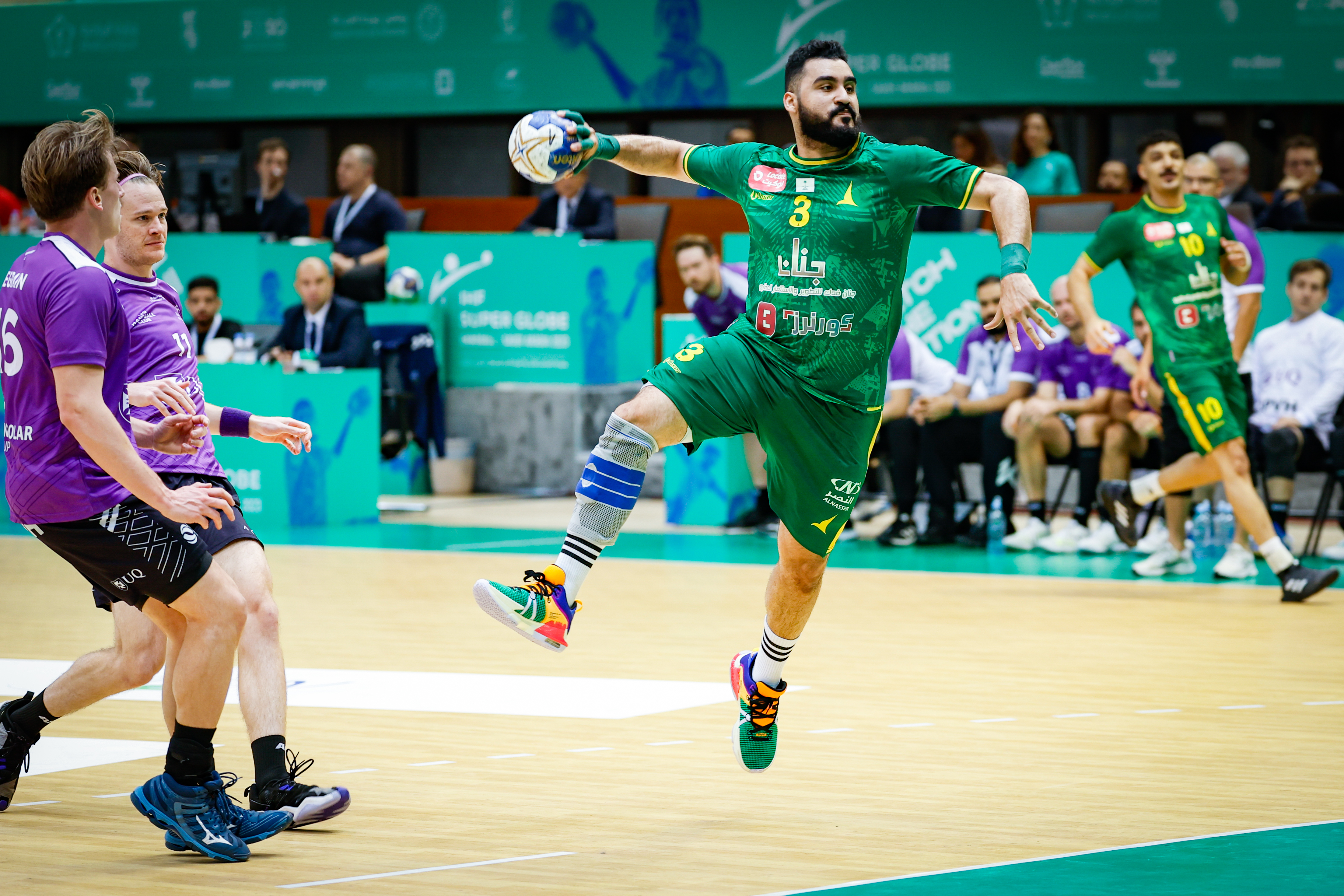
You might not have noticed from the extremely professional façade I portray on here, but in the last couple of years I’ve picked up the extremely fun and rewarding hobby of handball. It has become a really large part of my life, so much so that I interrupted my PhD from July through December this year because of it. Let me show you why.

Club champs

In July I competed for the UQ Handball Club at the Australia and Oceania Club Championships for the second time. And unlike last year, where I sat on the bench and eagerly absorbed as much as I could from the side-lines, another year of training (and the fortune of being the only left-hander on the team) earned me the responsibility of serious playtime. Five tough games later, we managed to pull off something the club had been working towards for the better part of a decade – toppling Sydney Uni, the reigning champions since 2014, and winning the final against St. Kilda.

This also earned us the right to compete at the 2023 IHF Super Globe, the annual handball club world championships held in November. Celebration soon turned to anticipation as we realised the hard work and sacrifice we would have to put in to mix it with some of the best professional clubs in the world.

Prep

With just over three months to prepare, we had to get started straight away. Four on-court trainings, three gym sessions and three running sessions each week is a lot to ask of people who otherwise still have full-time jobs and families. To me, I could see no way to balance this with tutoring and PhD work. I had committed to a lot of tutoring and semester had already started, so the PhD had to go. I made the arrangements to pause the PhD, and committed to this potentially once-in-a-lifetime opportunity. I’m very grateful to my supervisors and course co-ordinators for being flexible, supporting and understanding.

The preparation was tough, but by the end of the program I felt stronger, fitter and a lot better at handball. Of course, I learned a lot about myself and what motivates me to work hard, so it was a worthwhile experience for that reason alone.

The competition

It was always going to be tough playing against some of the best players in the world, especially when we hadn’t played on a stage like this before. There were a lot of firsts: first time playing in front of thousands of spectators, all supporting the other team; first time getting a police escort; first time playing against professionals; first time losing by 40+ goals. But you learn a lot about how you can improve in these situations, so we’re excited to work hard to do it all again next year. We set ourselves a benchmark, and showed that an Australian-based team can perform on the world stage.

What I learned

Individually, I know I have a lot to work on over the next twelve months to help the team get back to this position next year, and then give a better showing of myself if we get there. I learned to be resilient in times of adversity, and I learned what matters to me and how to better manage my time next year so I can manage my PhD as well as handball. (Farewell tutoring!) Finally, I learned to embrace opportunities when they arise, and enjoy every moment.

Analysing the value of Draft-Day Trades in the NFL

One of the most exciting and hotly debated topics at every NFL Draft is the trading of picks. Teams will make these trades for many reasons: moving up before the draft starts to get a Quarterback i.e. The Rams and Eagles, or jumping ahead a few picks to ensure that the apple of the GM’s eye doesn’t get taken just before their selection. For this reason, understanding the value of a certain pick number could really benefit a decision maker for an NFL team, and help take away the bias in every GM’s head that they are intrinsically better at picking than everyone else. This article will use similar methods to my article analysing the benefits of tanking in the NBA, but will instead focus on the value of a particular pick than whether or not the top picks lead to winning. Fair warning seeing as this is a basketball site: This is about the NFL. You have been warned.

The first thing that needs to be done when quantifying the value of historical picks is determining what metric should be used for evaluating players. Using yards or touchdowns would work for only skill-position players and tackles might work for defensive players, but we’d have no way of comparing between positions, and stats for offensive linemen are almost non-existent. Career earnings might be an effective measuring stick but this is already skewed by scaled rookie contracts and has no way of accounting for a player who fails to live up to their second contract. Pro-bowls and All-Pro selections might work, but these don’t tell the whole story, as a player can be greatly valuable to their team without earning any pro-bowl selections. Luckily, pro-football-reference has thought about this problem before, and devised their own method for measuring the career value of players called Approximate Value (AV). You can read about how it’s developed here. It properly accounts for many factors that end up with an accurate assessment of a player’s value.

Click here to view interactive versions of all of the tables which follow, as well as access the source data or download the workbook yourself.

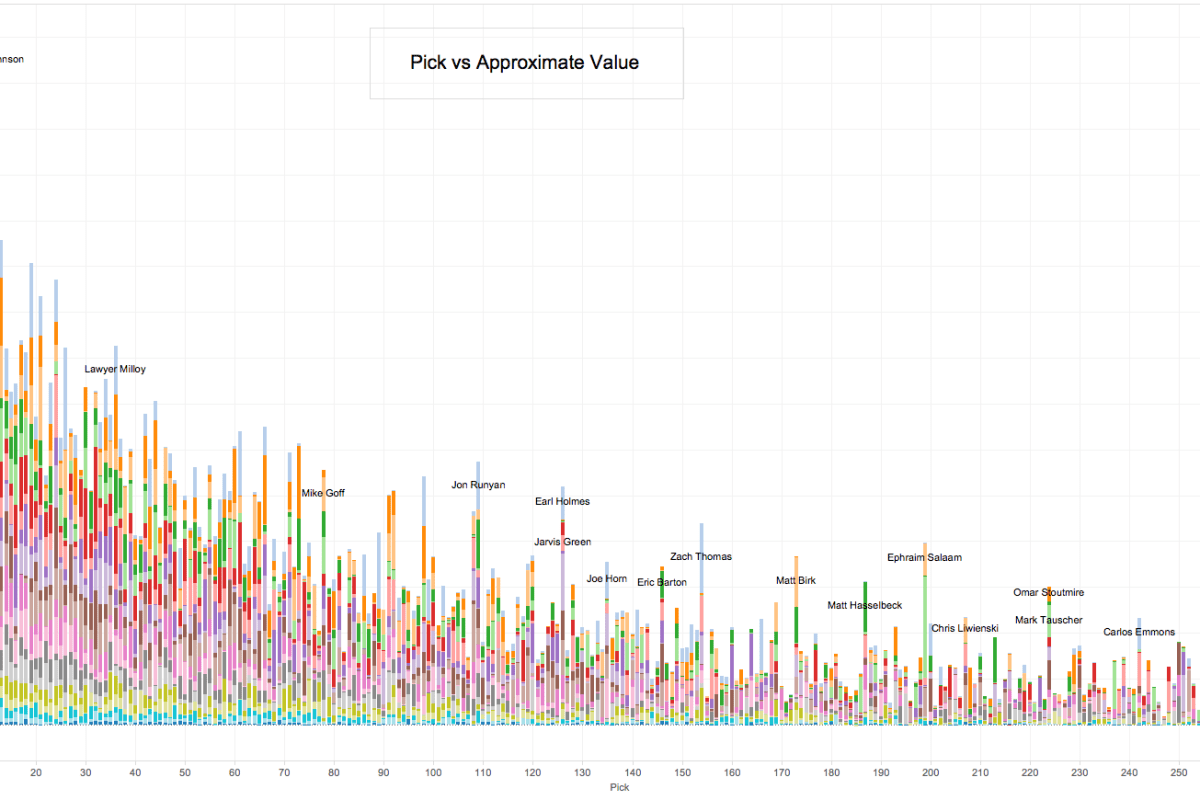
The first and most simple relationship to look at is Approximate Value vs Pick position. The following graph will contextualise the availability of talent over the course of the draft, with every player drafted since 1996 being used as the sample size for this investigation.

Screenshot 2016-05-09 15.34.50

It’s clear that the best players mostly go at the top of the draft, which is a good thing. We also see the number 1 pick adding the most value, which is a reasonable result, seeing as it’s the best pick to find a home-run hall-of-fame talent. We can also see that there are a lot of excellent players that get drafted deep into the final day of the draft, stories which most of us have probably heard about. However, there isn’t a great deal that can be taken from this graph because it is an absolute mess. We can’t simply attribute the value of each pick to its average AV, because it would be ignorant to say that the 199th pick is more valuable than the 80th pick because of a few lucky players including Tom Brady. We need some way of removing the outliers and looking at the sort of player you can expect to draft at a particular position.

The best way to do this is to instead look at the median AV for each pick position. This removes the outliers which are busts and steals. It also provides a great measure for the expected AV from a particular pick because 50% of historical picks were better than the median, and 50% were worse.

Screenshot 2016-05-12 10.10.38

We now see that we have a much less noisy graph from which we can gather some more information. Obviously there is still a lot of noise, as we have a fairly bumpy line, but with a simple trend line which has been plotted in grey, we have developed a formula which estimates the expected AV of a particular pick. A polynomial formula was chosen as it provided the best fit with the relatively high value of early picks and the steadily decreasing value of late round picks, finally tapering off to 0 with the so-called irrelevant picks at the end of the draft. The formula is of the n^3 type and is a bit messy, but looks like this:

Approximate Pick Value = -6.60394e-06*Pick^3 + 0.00362413*Pick^2 + -0.670325*Pick + 45.424

We also need to develop an estimate for the value of future draft picks, because we don’t know where a team’s pick will fall until the conclusion of the next season. By simply taking the median AV for all players selected in a particular round, we can get a fair approximation for the value of future picks. The main weakness of this calculation is that it includes supplementary picks at the end of particular rounds, which are not included in future trades, which would slightly negatively affect the value of particular rounds. But the effect is almost negligible due to the randomness of all picks.

Screenshot 2016-05-12 10.33.54

We see a similar shape to the pick-by-pick graph, so we know this is a reasonable graph. From here we are able to reasonably approximate the value gained or lost for some of the biggest trades in the 2016 draft.

The two that are most meaty to analyse are the trades made by the Rams and the Eagles to move up to the top of the draft to select Jared Goff and Carson Wentz. in the Goff trade that was completed first, the Rams received: 2016 – #1, #113, #177, and the Titans received: 2016 – #15, #43, #45, #76 and 2017 – 1st round, 3rd round.

Rams Receive: Pick Value
2016, #1 44.75729252606
2016, #113 6.42498575582
2016, #177 3.69645775198001
Total Value 54.87873603386
Titans Receive: Pick Value
2016, #15 36.1622659525
2016, #43 22.77598191242
2016, #45 21.9964542175
2016, #76 12.51330371456
2017, Round 1 36
2017, Round 3 10
Total Value 139.44800579698

So one can conclude that the Rams sacrificed 139.45 points of value to the Titans in return for 54.88 points of value. Now that’s not to say that the Rams strictly lost 85 points of value, all of this is entirely dependent on the specific situation a team is facing with regards to their roster. From the Ram’s point of view, they already have a pretty stacked roster everywhere outside of the Quarterback, so for them, adding a bunch of players at positions that they already have would suggest those players are less likely to add a lot of value to the Rams. Additionally, they’re expected to add 44.8 points of value with one player, their rookie quarterback, which is exactly the hole in the roster they need filled. So from the Rams perspective, it might be worth it to sacrifice 140 points of AV in return for 44.8 points of AV at one spot in the roster that needs filling. From the Titan’s perspective, however, this is an absolute slam dunk. Gaining a net 85 points of AV is a huge haul, which could turn into some very valuable players.

Let’s look at the other big trade of the offseason, the Eagles trading up with the Browns to select Carson Wentz.

Eagles Receive: Pick Value

2016, #2

44.09779368848

2017, Round 4

7

Total Value

51.09779368848

Browns Receive: value

2016, #8

40.28996310272

2016, #77

12.28152522998

2016, #100

8.02886

2017, Round 1

36

2018, Round 2

21

Total Value

117.6003483327

This trade isn’t as lopsided as the trade for the number 1 pick, which isn’t a big surprise considering the perceived greater value of the number 1 pick. However, it’s a considerable haul for the browns who have the opportunity to add 3 players with +20 AV. There’s plenty of picks which could be analysed, including countless draft-day trades where teams move up a couple of spots, most of which are not that interesting. For that reason, I created a spreadsheet that quickly calculates the AV traded in a particular swap of draft picks, which can be found here. Simply download your own version to edit the highlighted input areas and see how your team fared on draft day when it came to trades.

My analysis to this point has simply been on the amount of expected total value added or lost in a particular trade, but this somewhat misses the essence of trading draft picks for half of the league. While total AV is a great measure for teams looking to improve their entire roster like the Titans or Browns, it overlooks the desires of a team aiming to move up in the draft like the Eagles or Rams. For them, they’re more interested in trading a lot of players with reasonable AV for one player to fill one spot on the roster with as much AV as possible. For this reason, I thought it necessary to add another element of analysis to the calculus for trading picks.

While simply looking at which team got the pick with the highest estimated AV might provide some clarity here, it doesn’t tell the full story. It might be that a team moves up for the number 1 pick but in turn gives up a couple of picks which, combined, give a better chance at picking up a Pro-Bowl calibre player. The way to properly investigate this is to take the distribution of players which can be taken with a certain pick, by measuring the standard deviation of AV taken at a certain pick. Then, one can calculate the odds that a particular pick will result in a player with AV greater than a certain amount, say 60 AV (which is roughly the minimum value for an All-Pro player). Then, by taking the probability for all of the traded picks, one can quite easily calculate the odds that one of the picks turns into a +60AV player. Using this calculation, one can take another look at the two biggest trades analysed earlier and see if it more accurately reflects what the Eagles and Rams were aiming to gain from the trade.

In the Rams/Titans trade for the number 1 pick, it was pretty clear that the Titans pulled off an absolute heist when it came to total AV, which was their goal, as they need to put as much talent as possible around Marcus Mariota moving forward. But if we look at the odds of either team earning themselves a pro-bowl talent, the story changes slightly.

AV Titans Rams
total 139.4480058 57.2120127
40 0.7681549095 0.5579975043
50 0.5086942213 0.4446985388
60 0.3091670338 0.3405035364
70 0.1912181388 0.2478980144
80 0.1198511853 0.170811554
90 0.07298295843 0.1110815966
>100 0.04217354009 0.06802947466

We see that when it comes to gaining a player with AV greater than 40 or 50, the titans are still in front, which is expected, as these are scores for quality starters, the type of players the Titans were looking to add. But for earning a player with AV greater than 60, the ledger swings in favour of the Rams, who have increased their chances of finding themselves an All-Pro level talent at Quarterback. So it would seem that both the Rams and Titans have achieved their goal with the trade.

Now let’s look at the Carson Wentz trade, and see if we see a similar result with the Eagles.

AV Eagles Browns
total 51.09779369 117.6003483
40 0.5838220646 0.8030838151
50 0.421429454 0.579078266
60 0.2770324051 0.3653103498
70 0.1645533065 0.218933875
80 0.08754859688 0.1308536876
90 0.04140852509 0.0769407191
>100 0.01731490997 0.04345448672

Bad news for Eagles fans, your team got fleeced in the trade. Not only do the Browns pick up more total AV than the Eagles, but they also happen to have a higher chance of their picks turning into a difference maker. This demonstrates the reason why the Browns would be willing to gain less total AV from the trade, compared with the number 1 pick, because they seem to be aware of the fact that they’re gaining more picks that could be difference makers in the NFL. Aside: Normally with results like this I assume that the decision makers had their own reasons and opinions that happen to coincide with an analytical view-point, but given that the Browns have hired Paul DePodesta as Chief Strategy Officer, pioneer of moneyball in the MLB, I have a sneaky feeling that the Browns’ decision makers were looking at almost exactly the same numbers as I have here when deciding to accept the Eagles’ trade offer. Most likely they had a differing strategy to valuing picks than AV, but it no doubt would have yielded similar results.

There were dozens of other trades that went down on draft day that are worth looking, but it’s not worth putting them all in this article, so I encourage readers to play around with the spreadsheet here and see how the numbers shape up with the analysts’ opinions on the trades. There are a lot of unique situations to play around with, like teams moving up a couple of spots which has mixed results. Overall it appears to be that the negotiation skills of GMs can have a great swing on how much value a team earns in the trading process, as well as teams that are in the fortunate position of not needing to make blockbuster deals to stay competitive, i.e. the Packers, Steelers, Patriots or Cardinals. Overall, this tool should serve as one more method for evaluating the success of the trading of picks. Additionally, if any GMs are reading this, feel free to use the model to your advantage.

  • An Article By Jack Neubecker
  • Read about a similar article on tanking in the NBA
  • Read about how AV was developed here
  • Click here for interactive versions of the graphs used or to download the data
  • Use the interactive Spreadsheet to experiment with other trades
  • Statistics sourced from pro-football-reference

Hack-A-Who?

http://cdn.slamonline.com/wp-content/uploads/2016/04/andre-drummond.jpg

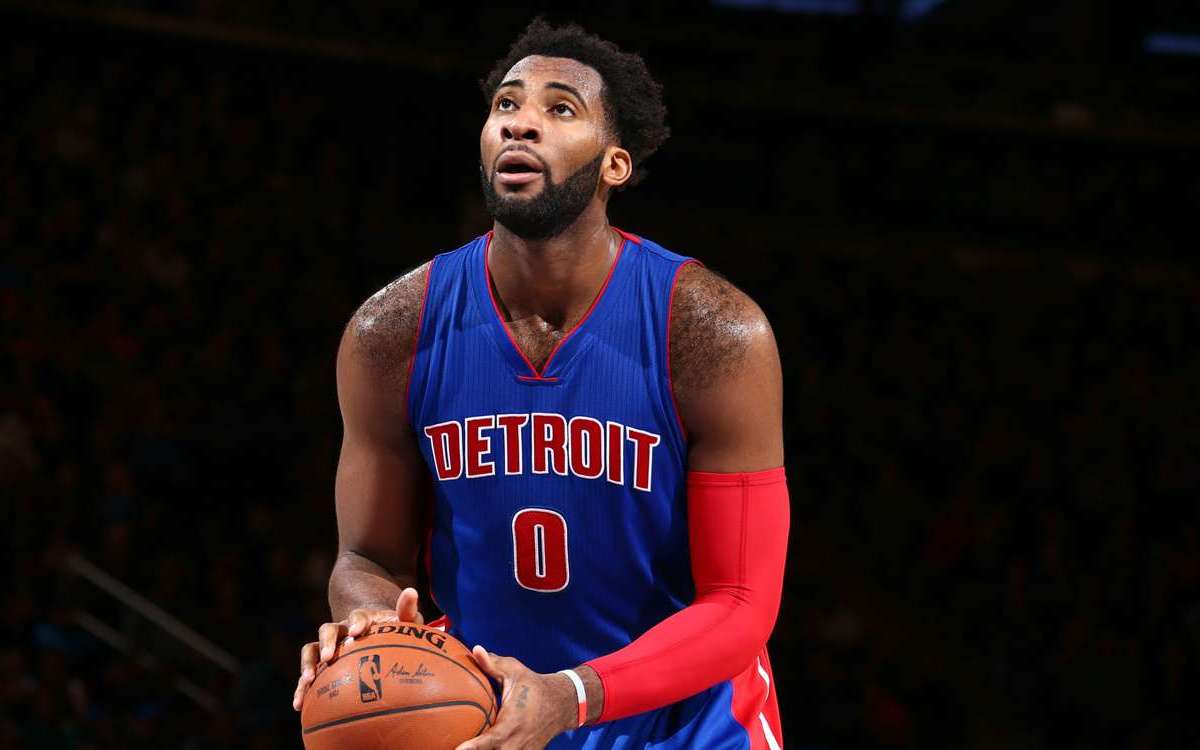
One of the biggest problems today that challenges the NBA as a whole is the Hack-a method of intentionally fouling a poor free throw shooter to send them to the line and end the opponent’s possession. The strategy is employed invariably to a handful of 7-footers who made their way into the NBA because of a huge wingspan, vertical and ability to create and finish shots around the rim, not their fine-motor skill to make stationary 15 foot shots. Generally it is employed as a last resort to try and slow down the offense, or in hopes of catching the player on a cold shooting night. But what is the statistical effectiveness of hacking a particular player? What free-throw percentage should players aim for to avoid getting hacked? This short article aims to answer those questions.

To determine when it is an effective strategy to hack a player, we need to construct a formula that calculates the expected points when you send a free throw shooter with a particular FT% to the line. Calculating expected points for the first possession is relatively easy. It can be expressed as 2* the likelihood of making both free throws, plus the likelihood of making 1 and missing one: 2*FT%*FT% + (1-FT%)*FT% + FT%*(1-FT%). This simplifies to a nice wholesome 2*FT%. But as my high school coach taught me, the possession isn’t over until the board has been cleared. So we have to account for the likelihood of an offensive rebound. According to SportVU’s data, the likelihood of the offense rebounding a missed free throw is 11.5%. So the probability of catching an offensive rebound and restarting the possession is 11.5%*(making the first, missing the second + missing both): 11.5%*(FT%*(1-FT%) + (1-FT%)*(1-FT%)), which simplifies to 11.5%*(1-FT%).

For the purpose of this exercise, we’ll assume the defending team decides to hack again after an offensive board. So we’re back in the same position again, and there’s a chance that we go round and round in a continuous stream of missed free throws and offensive rebounds. Luckily maths provides an easy solution to these infinite sums. So we eventually find that the formula looks like 2*FT%/(85.5%-11.5%*FT%).

So that’s expected points off every possession, but we want to know whether that’s better than letting the opponent run its offense. Simple, a player’s score is the difference between their team’s offensive rating and their expected points off shooting foul shots. Below is a table of every player with ≥50 attempts whose score is negative, meaning it’s effective to try and hack them.

Player Team FT FTA FT% Points lost/Possession
Andre Drummond DET 208 586 35.5% 0.294
Clint Capela HOU 80 211 37.9% 0.266
DeAndre Jordan LAC 266 619 43.0% 0.162
Andrew Bogut GSW 24 50 48.0% 0.123
Thomas Robinson BRK 47 109 43.1% 0.109
J. J. Hickson DEN 27 59 45.8% 0.079
Dwight Howard HOU 232 474 48.9% 0.043
Festus Ezeli GSW 70 132 53.0% 0.024

Find the spreadsheet with every player’s scores here.

First on the list to nobody’s surprise, Andre Drummond. Also featuring are the two other players most noted for being hacked, DeAndre Jordan and Dwight Howard. Some surprises on the list, Andrew Bogut and Festus Ezeli. Sure, Bogut only has 50 attempts on the season, but the numbers would suggest that hacking him is an effective strategy, one that is never discussed when discussing how to beat the Warriors. Sure, he only plays 20.7 minutes per game, and the Warriors love their small-ball lineups, but sending Bogut to the line might work for the time where he is out there. Throw in a cold season and only making 24 free throws in the entire season, and he might be a bit shaky at the charity stripe. So just keep that in mind coaches facing the warriors in future.

Those numbers should be taken with the understanding that it’s the team’s average offensive rating. Hacking a player may be more or less effective against certain line-ups.

So, without advocating for an ugly basketball tactic, those are the players who should be intentionally fouled. But what should players aim for to avoid having to play a game of tag against every player on the opposition? Obviously this changes slightly depending on the strength of your team’s offense, but this graph would suggest a pretty boring old 50%. FT% v FTx

Find the full graph here.

BONUS QUESTION: How good of a free throw shooter should I be to make both of my shots more than I miss one of them? 71%. What about a 3-point foul? 79.4%. What about 10 in a row? 93.3%. The solution to making n shots in a row ≥50% of the time is 0.5^(1/n). Just a little nugget I discovered a while ago that I needed to share but haven’t found the right time.

So that’s that. For all the NBA coaches out there reading, feel free to use this formula to your advantage when scheming on how to slow down a superior offense. Terry Stotts, I’m talking to you.

  • An Article by Jack Neubecker
  • Statistics Sourced from Basketball Reference
  • If the above numbers file doesn’t run, try this excel document

http://cdn.slamonline.com/wp-content/uploads/2016/04/andre-drummond.jpg

Who Are the Best 3 Point Shooters in NBA History?

In my most recent article, I devised a new metric for measuring the effectiveness of 3 point shooters that accounts for both efficient shooting and a volume of shots, which is important to the effectiveness of the 3. I used player data from the 2015-16 regular season to explore the ways that this metric could be used to evaluate effectiveness. In this article, I’ll take this metric, and apply it the the most prolific 3 point shooters in NBA history to see how they all stack up. To read up on how the metrics work and how they apply to the 2015-16 crop of players, click here.

Instead of the 2015-16 Offensive Rating averages I used the average of averages since the introduction of the 3 point line. Additionally, I also limited the players to those who had attempted 500 or more shots in their career, so as to eliminate a swarm of meaningless dots. This left 540 players, a suitably large sample size, 500 attempts is not a great deal to achieve. This analysis will provide interesting insight into the most effective 3 point shooters of all time in a more useful way than total 3 pointers made or 3 point percentage, and will also inform judgement about players who shot poorly from the 3 point line.


If the above embedded graphs don’t display in your browser, click here to view them on tableau.com.

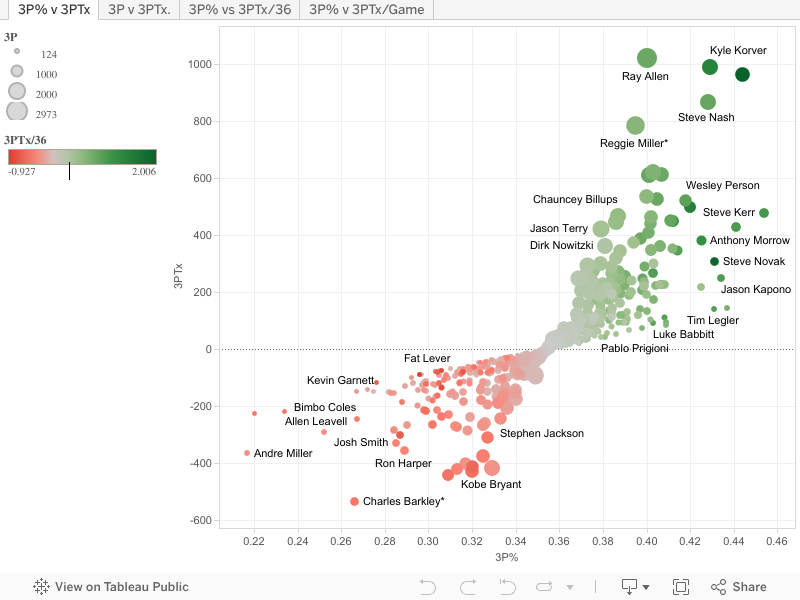
Let’s start with simple 3PTx, where we see that there are a clear 5 best shooters of all time. Reggie Miller, Steve Nash, Steph Curry, Kyle Korver and Ray Allen. First of all, Ray Allen, 1020 points added through the 3-ball is just incredible, and the rest of the numbers are almost equally as astounding. What I found most interesting from this graph is that Steph is already 3rd all time, which is just incredible, who knows how far above the rest of the pack he could be by the end of his career. When I asked Editor-In-Chief Elliott to name who he thought were the 5 at the top of the list, he named all but Steve Nash. This makes sense, because he’s often not brought up as one of the best shooters of all time, but it’s clear just how good he was when you see him perched above Reggie Miller. Kyle Korver also gets a lot of love, a player whom we don’t yet contextualise as one of the best 3 point shooters of all time but almost certainly is. Finally on the positive end of the graph, We see Steve Kerr fall back to earth from his best 3 point percentage of all time. Should have jacked up more shots like your underlings on the Warriors, Kerr, you would have been way more effective.

Let’s now look at the bottom of the graph, some of the worst shooters of all time. Charles Barkley at the bottom of the list, costing his team 534 points off ill-advised 3 point attempts. No wonder he’s so jealous of the Warriors and keeps coming out with hot takes doubting them. We also see KOBE near the bottom of the list, not the great shooter he’s perceived to be, at least from 3 point land. It’s a shame, because I thought more advanced analytics might justify his chucker mentality, but when it comes to bricking contested threes, they don’t come much better. We also see Allen Iverson near the bottom of the list, and what becomes a consistent theme of Andre Miller in a league of his own when it comes to bad shooting. It’s also interesting looking at all of the other players you find nested in the bottom half of the list, like Dwyane Wade, Clyde Drexler, Stephen Jackson or Michael Jordan. Obviously, these players’ contributions were not defined by their 3 point shooting.

Next, looking at 3PTx., we see Steve Kerr back at the top because of his more conservative trigger with the long range shot, and not too much can be learnt from this, as it is very similar in nature to the simple 3P% metric. Moving on.

looking at 3PTx/36, we see Steph Curry is by far the best shooter of all time, which gives promise that if he can continue to play like he has been in the last two MVP seasons, he is going to absolutely destroy every 3 point record known to man that he hasn’t already thrown by the wayside. We also see Steve Novak get some vindication, if anybody needed convincing that he wasn’t the best 3 point shooter of all time until Curry came along. We also see Klay Thompson coming in 3rd all time. It’s just incredible to think you’re justified in saying that the Warriors literally have the two best 3 point shooters of all time on their team. Some of the historic players on the list have been bumped further down the list and we see more modern players rise to the top, most likely a product of the fact that coaches encourage their shooters to take more attempts per game. We also see Marcus Smart, a player we might recognise from the 2015-16 data as a Chucker. By the numbers, he jacks up the most bad 3 point attempts per 36 of any player, in the history of the league. We also see players like KOBE with numbers that don’t look so bad given the amount of games they’ve played.

Finally, a look at 3PTx/game, which removes the occasional outliers like Steve Novak, and gives a clear look at which players are able to find the most looks from beyond the arc in a game and most help their team on the offensive end. What do we find? Klay Thompson and Steph Curry at the top of the list. Incredible. Marcus Smart once again, huge chucker, and Steve Novak still incredibly high on the list, right on par with Steve Nash.

The next step for this metric is to improve the personalisation. Instead of applying a league wide Offensive Rating, applying the Offensive Rating of each player’s team for that season would provide further accuracy, as a 3 point shooter isn’t passing up a 3 to a league average team, he’s passing it up to the team he’s currently on, so it would favour players who needed to take more 3s because they were on a bad team.

Let me know what you think of the metric and if you’ve got any comments or suggestions for improvements, I’m all ears.

  • Statistics provided by Basketball-Reference
  • Graphs provided by tableau.com
  • Read about how the metric works and how it applies to the 2015-16 class here
  • twitter: @jackneubecker
  • email: pointforwardpod@gmail.com
  • An Article by Jack Neubecker