Hack-A-Who?

http://cdn.slamonline.com/wp-content/uploads/2016/04/andre-drummond.jpg

One of the biggest problems today that challenges the NBA as a whole is the Hack-a method of intentionally fouling a poor free throw shooter to send them to the line and end the opponent’s possession. The strategy is employed invariably to a handful of 7-footers who made their way into the NBA because of a huge wingspan, vertical and ability to create and finish shots around the rim, not their fine-motor skill to make stationary 15 foot shots. Generally it is employed as a last resort to try and slow down the offense, or in hopes of catching the player on a cold shooting night. But what is the statistical effectiveness of hacking a particular player? What free-throw percentage should players aim for to avoid getting hacked? This short article aims to answer those questions.

To determine when it is an effective strategy to hack a player, we need to construct a formula that calculates the expected points when you send a free throw shooter with a particular FT% to the line. Calculating expected points for the first possession is relatively easy. It can be expressed as 2* the likelihood of making both free throws, plus the likelihood of making 1 and missing one: 2*FT%*FT% + (1-FT%)*FT% + FT%*(1-FT%). This simplifies to a nice wholesome 2*FT%. But as my high school coach taught me, the possession isn’t over until the board has been cleared. So we have to account for the likelihood of an offensive rebound. According to SportVU’s data, the likelihood of the offense rebounding a missed free throw is 11.5%. So the probability of catching an offensive rebound and restarting the possession is 11.5%*(making the first, missing the second + missing both): 11.5%*(FT%*(1-FT%) + (1-FT%)*(1-FT%)), which simplifies to 11.5%*(1-FT%).

For the purpose of this exercise, we’ll assume the defending team decides to hack again after an offensive board. So we’re back in the same position again, and there’s a chance that we go round and round in a continuous stream of missed free throws and offensive rebounds. Luckily maths provides an easy solution to these infinite sums. So we eventually find that the formula looks like 2*FT%/(85.5%-11.5%*FT%).

So that’s expected points off every possession, but we want to know whether that’s better than letting the opponent run its offense. Simple, a player’s score is the difference between their team’s offensive rating and their expected points off shooting foul shots. Below is a table of every player with ≥50 attempts whose score is negative, meaning it’s effective to try and hack them.

Player Team FT FTA FT% Points lost/Possession
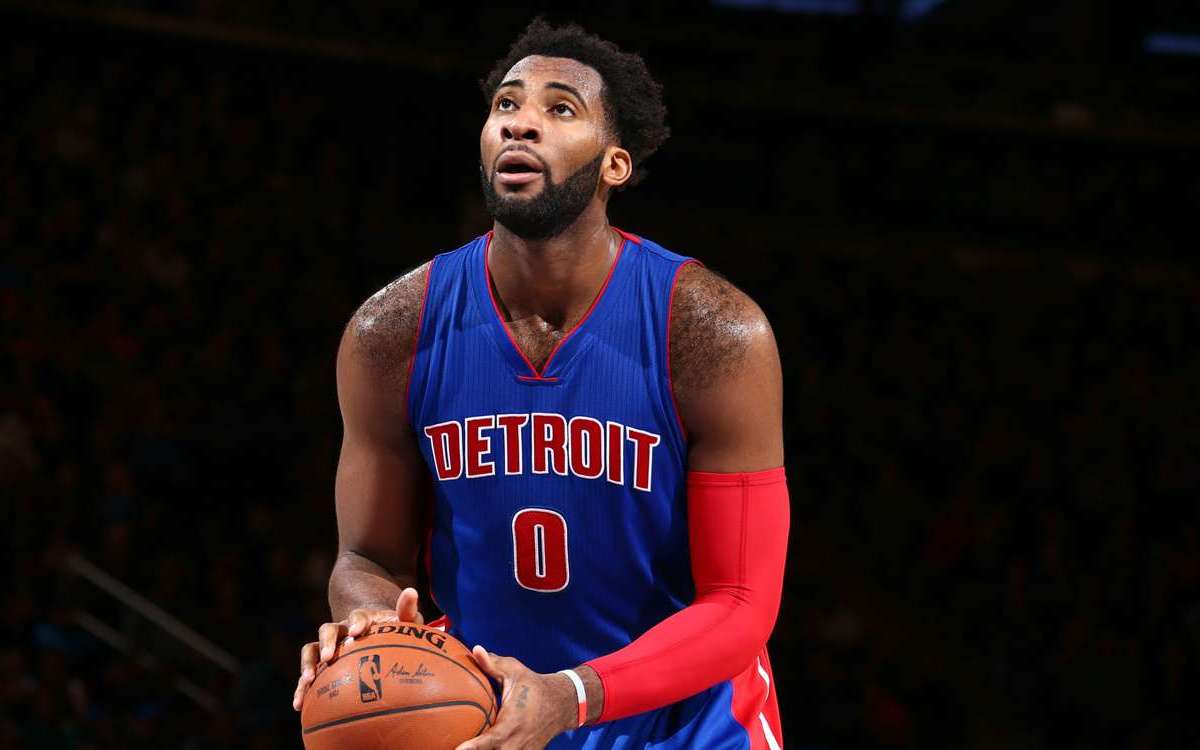
Andre Drummond DET 208 586 35.5% 0.294
Clint Capela HOU 80 211 37.9% 0.266
DeAndre Jordan LAC 266 619 43.0% 0.162
Andrew Bogut GSW 24 50 48.0% 0.123
Thomas Robinson BRK 47 109 43.1% 0.109
J. J. Hickson DEN 27 59 45.8% 0.079
Dwight Howard HOU 232 474 48.9% 0.043
Festus Ezeli GSW 70 132 53.0% 0.024

Find the spreadsheet with every player’s scores here.

First on the list to nobody’s surprise, Andre Drummond. Also featuring are the two other players most noted for being hacked, DeAndre Jordan and Dwight Howard. Some surprises on the list, Andrew Bogut and Festus Ezeli. Sure, Bogut only has 50 attempts on the season, but the numbers would suggest that hacking him is an effective strategy, one that is never discussed when discussing how to beat the Warriors. Sure, he only plays 20.7 minutes per game, and the Warriors love their small-ball lineups, but sending Bogut to the line might work for the time where he is out there. Throw in a cold season and only making 24 free throws in the entire season, and he might be a bit shaky at the charity stripe. So just keep that in mind coaches facing the warriors in future.

Those numbers should be taken with the understanding that it’s the team’s average offensive rating. Hacking a player may be more or less effective against certain line-ups.

So, without advocating for an ugly basketball tactic, those are the players who should be intentionally fouled. But what should players aim for to avoid having to play a game of tag against every player on the opposition? Obviously this changes slightly depending on the strength of your team’s offense, but this graph would suggest a pretty boring old 50%. FT% v FTx

Find the full graph here.

BONUS QUESTION: How good of a free throw shooter should I be to make both of my shots more than I miss one of them? 71%. What about a 3-point foul? 79.4%. What about 10 in a row? 93.3%. The solution to making n shots in a row ≥50% of the time is 0.5^(1/n). Just a little nugget I discovered a while ago that I needed to share but haven’t found the right time.

So that’s that. For all the NBA coaches out there reading, feel free to use this formula to your advantage when scheming on how to slow down a superior offense. Terry Stotts, I’m talking to you.

  • An Article by Jack Neubecker
  • Statistics Sourced from Basketball Reference
  • If the above numbers file doesn’t run, try this excel document
http://cdn.slamonline.com/wp-content/uploads/2016/04/andre-drummond.jpg

Who Are the Best 3 Point Shooters in NBA History?

In my most recent article, I devised a new metric for measuring the effectiveness of 3 point shooters that accounts for both efficient shooting and a volume of shots, which is important to the effectiveness of the 3. I used player data from the 2015-16 regular season to explore the ways that this metric could be used to evaluate effectiveness. In this article, I’ll take this metric, and apply it the the most prolific 3 point shooters in NBA history to see how they all stack up. To read up on how the metrics work and how they apply to the 2015-16 crop of players, click here.

Instead of the 2015-16 Offensive Rating averages I used the average of averages since the introduction of the 3 point line. Additionally, I also limited the players to those who had attempted 500 or more shots in their career, so as to eliminate a swarm of meaningless dots. This left 540 players, a suitably large sample size, 500 attempts is not a great deal to achieve. This analysis will provide interesting insight into the most effective 3 point shooters of all time in a more useful way than total 3 pointers made or 3 point percentage, and will also inform judgement about players who shot poorly from the 3 point line.


If the above embedded graphs don’t display in your browser, click here to view them on tableau.com.

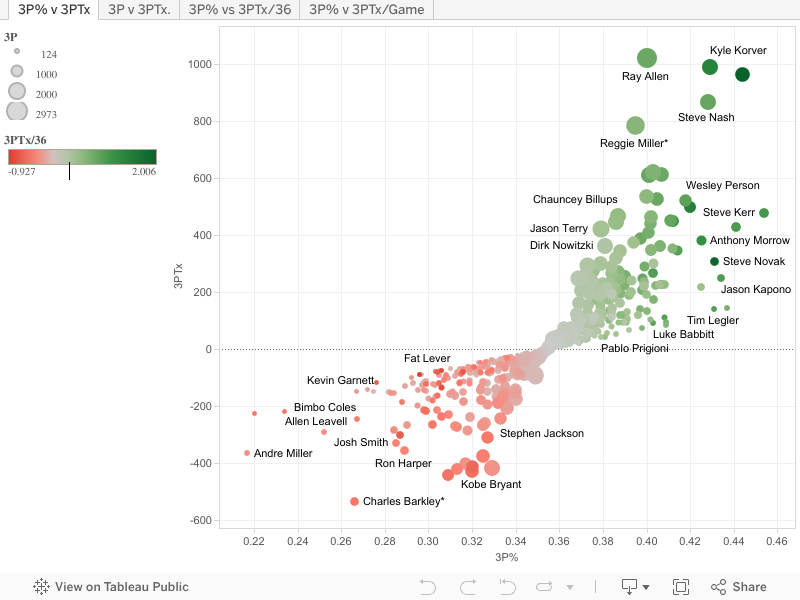
Let’s start with simple 3PTx, where we see that there are a clear 5 best shooters of all time. Reggie Miller, Steve Nash, Steph Curry, Kyle Korver and Ray Allen. First of all, Ray Allen, 1020 points added through the 3-ball is just incredible, and the rest of the numbers are almost equally as astounding. What I found most interesting from this graph is that Steph is already 3rd all time, which is just incredible, who knows how far above the rest of the pack he could be by the end of his career. When I asked Editor-In-Chief Elliott to name who he thought were the 5 at the top of the list, he named all but Steve Nash. This makes sense, because he’s often not brought up as one of the best shooters of all time, but it’s clear just how good he was when you see him perched above Reggie Miller. Kyle Korver also gets a lot of love, a player whom we don’t yet contextualise as one of the best 3 point shooters of all time but almost certainly is. Finally on the positive end of the graph, We see Steve Kerr fall back to earth from his best 3 point percentage of all time. Should have jacked up more shots like your underlings on the Warriors, Kerr, you would have been way more effective.

Let’s now look at the bottom of the graph, some of the worst shooters of all time. Charles Barkley at the bottom of the list, costing his team 534 points off ill-advised 3 point attempts. No wonder he’s so jealous of the Warriors and keeps coming out with hot takes doubting them. We also see KOBE near the bottom of the list, not the great shooter he’s perceived to be, at least from 3 point land. It’s a shame, because I thought more advanced analytics might justify his chucker mentality, but when it comes to bricking contested threes, they don’t come much better. We also see Allen Iverson near the bottom of the list, and what becomes a consistent theme of Andre Miller in a league of his own when it comes to bad shooting. It’s also interesting looking at all of the other players you find nested in the bottom half of the list, like Dwyane Wade, Clyde Drexler, Stephen Jackson or Michael Jordan. Obviously, these players’ contributions were not defined by their 3 point shooting.

Next, looking at 3PTx., we see Steve Kerr back at the top because of his more conservative trigger with the long range shot, and not too much can be learnt from this, as it is very similar in nature to the simple 3P% metric. Moving on.

looking at 3PTx/36, we see Steph Curry is by far the best shooter of all time, which gives promise that if he can continue to play like he has been in the last two MVP seasons, he is going to absolutely destroy every 3 point record known to man that he hasn’t already thrown by the wayside. We also see Steve Novak get some vindication, if anybody needed convincing that he wasn’t the best 3 point shooter of all time until Curry came along. We also see Klay Thompson coming in 3rd all time. It’s just incredible to think you’re justified in saying that the Warriors literally have the two best 3 point shooters of all time on their team. Some of the historic players on the list have been bumped further down the list and we see more modern players rise to the top, most likely a product of the fact that coaches encourage their shooters to take more attempts per game. We also see Marcus Smart, a player we might recognise from the 2015-16 data as a Chucker. By the numbers, he jacks up the most bad 3 point attempts per 36 of any player, in the history of the league. We also see players like KOBE with numbers that don’t look so bad given the amount of games they’ve played.

Finally, a look at 3PTx/game, which removes the occasional outliers like Steve Novak, and gives a clear look at which players are able to find the most looks from beyond the arc in a game and most help their team on the offensive end. What do we find? Klay Thompson and Steph Curry at the top of the list. Incredible. Marcus Smart once again, huge chucker, and Steve Novak still incredibly high on the list, right on par with Steve Nash.

The next step for this metric is to improve the personalisation. Instead of applying a league wide Offensive Rating, applying the Offensive Rating of each player’s team for that season would provide further accuracy, as a 3 point shooter isn’t passing up a 3 to a league average team, he’s passing it up to the team he’s currently on, so it would favour players who needed to take more 3s because they were on a bad team.

Let me know what you think of the metric and if you’ve got any comments or suggestions for improvements, I’m all ears.

  • Statistics provided by Basketball-Reference
  • Graphs provided by tableau.com
  • Read about how the metric works and how it applies to the 2015-16 class here
  • twitter: @jackneubecker
  • email: pointforwardpod@gmail.com
  • An Article by Jack Neubecker

Who Are the Best 3 Point Shooters?

The 3 point shot is quickly becoming one of the most important plays to perfect on the offensive end. Coaches are beginning to realise the untapped potential of the long-range shot, and are starting to focus more of their offensive plays on getting good shooters open for 3 point shots, especially in the corner, which is becoming the most efficient play in basketball. Players are spending more time practicing the 3 point shot, and we’re seeing a lot more 4s and 5s working on the craft and floating around the perimeter, an almost unheard-of concept only a decade ago.

The league average for 3 point shots in the 2015-16 season was 35.4%, for an expected points per attempt of 1.062, vs the 2 point shot which is made at a league average of 49.1%, for expected points per shot of 0.982. The concept of Nash Equilibrium would suggest that there is an inefficiency in the shot selection of offenses, so we can only expect 3 point attempts to increase in the future. For those who don’t know, Nash Equilibrium is the idea that strategy selections in a game will eventually even out as better strategies are chosen more by players, and countered more often by their opponents. Applied to basketball, it suggests that offenses will continue to shoot more 3s, and defenses will focus more attention to 3s, until the expected points for 3s v 2s is the same, a state of equilibrium. For this reason, a good understanding of where these extra shots should come from, and who the best 3 point shooters are is an important factor to any decision maker on the basketball court.

Currently, there exist a handful of incomplete metrics for measuring the effectiveness of a 3 point shooter. 3 point percentage is nice, it gives you a good idea of the likelihood of one of their shots getting in the hoop, but as with any rate statistic, it comes with flaws. Most of them stem from the fact that shot selection and volume account for so much of the minute differences between good and great shooters. The best 3 point shooter of all time according to 3P% is Steve Kerr, who had a career rate of 45.4%. That’s great, but he only made an average of 0.8 3s per game. Contrast this with Steve Nash, who shot at a lower 42.8% but made 1.4 3s per game. Shooting at a great click is useful, but only if you use it. Having a high 3 point percentage is good, but it’s useless if you don’t use it as much as a player with a slightly lower percentage. So 3 point percentage can’t be our only metric for deciding 3 point effectiveness.

So if pure efficiency isn’t going to cut it, let’s try a volume stat instead. 3 Pointers per game should be a good measure. If 3 points are worth more than 2, the more made 3s the better, right? Wrong. If you go by 3P/G, LeBron James (1.4) is just as good of a 3 Point shooter as Steve Nash (1.4). But LeBron James’ career mark is a meagre 34.0%, as opposed to Steve Nash at a much better rate of 42.8%. Nash (3.2 3PA/G) takes 0.8 less attempts than LeBron (4.0 3PA/G) to make his 3s, so Nash is clearly a better shooter, and going purely off volume metrics isn’t going to be very helpful either. What is needed is a metric that effectively combines efficiency with a volume of efficiency.

The ultimate mark of a good 3 point shooter should be the amount of points that they score greater than the expected points off every possession which they end with a 3 point shot. Simplified, this is “points off threes subtract expected points”. The method for determining expected points off a possession was to take the average Offensive Rating for the league (Points/100 possessions) and divide by 100. This gives an expected points per possession for the 2015-16 season of 1.064. The formula for calculating how much better than 1.064 points per possession each 3 point shooter was, is 3*3P – 1.064*3PA. Now we have our formula, we can apply it to every player in the league to judge their 3 point effectiveness. All we need is a name — I started using 3PTEPA for 3PT Expected Points Added as a tip to some of Baseball’s divisive sabremetrics, and eventually settled on 3PTx, 3PT Expected. Plus, 3PTx sounds pretty edgy so I went with it.

So let’s dive right in and have a look at the results when applied to player data for the 2015-16 season.


If your browser isn’t displaying the embedded graphs above, click here to view the interactive graphs on tableau.com. Scroll over data points for information about that player. To zoom in on a particular area, highlight that area, then hold the mouse over it until a box appears, and click “Keep Only”. Use the tabs up the top to switch between graphs.

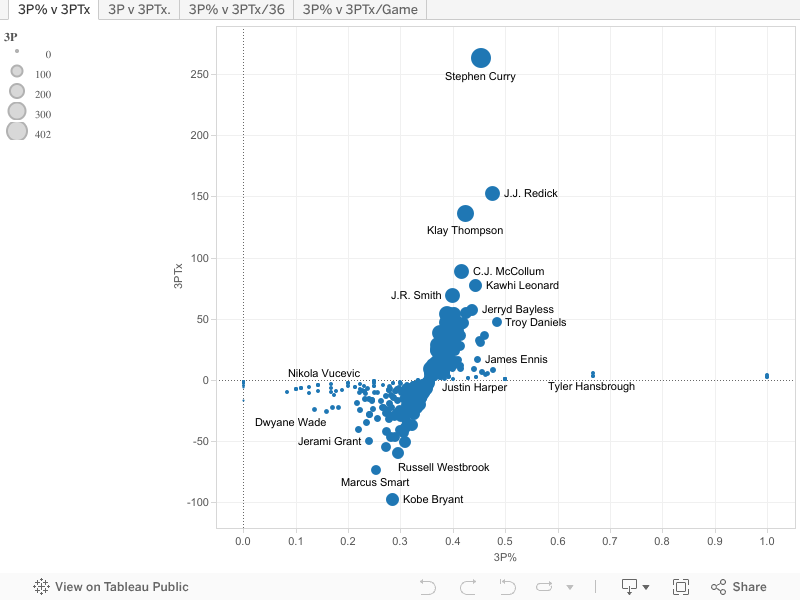
First, let’s simply look at 3PTx. To nobody’s surprise, Steph Curry is head and shoulders above the rest of the cohort, adding 263.3 points this season on 3 point shooting alone. More than 100 points behind we have our second tier of shooters, Klay Thompson and JJ Redick, followed by our third tier of CJ McCollum, Kawhi Leonard and JR Smith.

At the other end of the graph, we can see which shooters have been hurting their team with every 3 point attempt this season. At the bottom, with -97.9 points is Kobe Bryant. It’s no surprise, because only Kobe has the respect to keep chucking up low percentage shots and not get benched, and this is a single-season number we may not see again for a long time. Zooming in on the bottom end shows us some of the other players with the worst shooting seasons, including names like Marcus Smart, Russell Westbrook, Corey Brewer, Jerami Grant and Kentavious Caldwell-Pope all garnering scores below -50.

So what can we learn about this graph in general? Well, for those at the very top of the graph, shoot more. For those at the very bottom, shoot less. But for the majority of players clumped into the middle of the graph, it’s a little more complicated. In the middle, it’s best to split our graph along a diagonal line like so:

Screenshot-2016-04-28-16.07.28

For those who fall above and to the left of the line, they can attribute their negative score mostly to just being bad shooters. For those who fall below and to the right of the line, their score can be attributed primarily to putting up a volume of bad shots. Additionally, for players who, over the entire season, have a score of -20 or better, it’s worth considering that those attempts might not be that much of a negative influence. For example, players like John Wall or Gordon Hayward, who had season 3PTx scores of -4.0 and -7.2 respectively. Part of the 3 point shot is forcing the defense to respect you on the perimeter. If Wall or Hayward had shot considerably less from 3 this season, they probably would have a harder time getting to the rack as opponents sag off, as well as spreading the floor less for their team mates. So sometimes with players you need to take the good with the bad. However, if Wall had chosen not to take only 4 extra attempts this season, he would have broken even, so players with negative scores should still learn from that statistic when deciding to force a possibly ill-advised 3 point shot.

It’s very interesting to look at where a lot of players lie on this graph, some of the most interesting ones I’ll note here. Marvin Williams is on the same level of shooters as players like Kyle Lowry, Kevin Durant, and Kyle Korver, right at the top of the main pack, proving once again how much of an underrated season he’s having for the Hornets. Players considered by most to be good shooters who had a terrible season: Monta Ellis (-39.0), Nik Stauskas (-27.8), Danny Green (-23.3) and Paul Pierce (-32.5). Also, more proof of how poor LeBron James’ shooting has become this season, costing his team 39.0 points on the 3 ball for only 87 makes on the season. Stop shooting 3s LeBron. Please. Continuing on the stars who shoot 3s too much, Carmelo Anthony (-14.8) hasn’t had a great season. There are also a lot of players considered to be stretch fours or shooting bigs that find themselves with negative scores. Serge Ibaka (-15.8), Kristaps Porzingas (-15.6), Al Horford (-8.4) some of the biggest names, however as discussed before, the floor-stretching they provide may be worth the lost points.

Finally, it’s worth noting that the watershed mark for good or bad 3 point shooting is right around the 35% to 36% mark, which seems to gel with the consensus opinion around the league, which shows that our perception of 3 point shooters is reasonably consistent with game theory.

The 3PTx statistic provides a good look at the overall impact of a player’s 3 point shooting on the season, but a per-shot perspective might give us a better look at which players cause the most damage with every shot, and which players can afford to take more threes to up their efficiency. The next tab on tableau.com displays 3PTx. plotted on total 3 pointers taken. 3PTx. is simply calculated by 3PTx divided by 3 Pointers attempted.

Simply looking at where players fall along a ladder of 3PTx. scores would be interesting enough, but fleshing out the points by looking at total 3s gives us a good idea of how much of a player’s 3PTx. score can be attributed to low sample size, and if so, how many more shots they can afford to take.

Here, we get a better look at some players who have been neglected on the 3 point line. The players we see at the top of the graph with only a handful of attempts can obviously be ignored, because their percentages came off a very small sample size. This metric suffers from a lot of the same flaws as simple 3PT%, but it does benefit from at least giving a reference point of whether a given rate is a good or bad percentage.

For players who find themselves below the 0 3PTx. line, it’s better for them to additionally be found with less 3 pointers made, because the more that come off a bad rate, the more a player is hurting their team. For those above the line, they should want to find themselves with as many 3 pointers made as possible, because each attempt is good for the team. Information about individual players can’t be explored as much as with the previous graph.

The third graph plots 3PTx/36, a measure of how many points a player adds through 3 pointers per 36 minutes of court time. Steph Curry finds himself highest amongst high volume players, to no surprise, but we also find a few players around his range whose value on the court may have been overlooked when it comes to the 3 pointer. Steve Novak and Troy Daniels stand out the most, but obviously these players have bigger flaws in their game which force coaches to sit them, despite their good 3 point shooting. This measure is best for judging players in the middle of the pack and comparing similar players, just like other /36 statistics.

The final graph plots 3PTx/Game, another metric which provides a good equaliser, however this stat is more effective for multi-season comparison, or contextualising a number. This graph will be much more interesting when comparing historical players, whereas for single-season data it looks almost exactly the same as the first graph which simply plots 3PTx.

It should be seen from this rudimentary exploration of the results how effective 3PTx is as a measure of 3 point shooting. This statistic would be a good advanced stat to use in analysis of a player’s shooting, and provides a single number on the level of box-plus-minus or Win Shares which immediately allows one to make conclusions about whether a player’s shooting is a negative or a positive. In my next article, I will be applying this data to historical 3 point shooters and subsequently judging the best and worst players of all time when it comes to long-range shooting. Further down the road, I am looking to try and implement a similar strategy to a player’s entire scoring output, to discover who the best all around scorers of all time are. But until then, enjoy the use of this metric for analysing 3 point shooters. Contact me if you’ve got any suggestions for how this metric could be improved, or your general thoughts.

  • statistics provided by Basketball Reference
  • Graphs provided by Tableau.com
  • Read about how this statistic applies to all-time 3 point shooters here
  • twitter: @jackneubecker
  • email: pointforwardpod@gmail.com
  • An Article by Jack Neubecker

An Honest Reflection on Tanking

How Effective is Tanking?

In the wake of Sam Hinkie’s resignation as GM of the Philadelphia 76ers, there has been a lot of reflection about the effectiveness of his aggressive strategy. First of all, this is pretty unfair on Hinkie, because the job isn’t done yet – it’s about now that the 76ers land themselves a star in Brandon Ingram or Ben Simmons, and use that to lure a free agent and start to climb their way back to the top, but that’s just an aside. As a result of this, a lot of subsequent discussion has followed about the effectiveness of tanking in general. The most oft-used strategy for breaking this down is a lot of anecdotal, team-by-team evidence. Analysts will point to the Warriors as an example of how to win a championship without a number one pick, and their debating opponents will immediately fire back with the half-dozen championships won by number 1 picks in LeBron and Duncan in recent NBA history. After listening to this debate from both sides of the argument for a few days, I started brooding and pondering, and eventually decided I should investigate with some rigorous statistical analysis that removes the element of ambiguity.

Before I get into the research I conducted, I’ll just lay some groundwork for this discussion. Right off the bat, I’ll ask the question: “Which teams haven’t been bad in the past 8 years?” – the answer is a list of 6 teams, give or take: the Spurs, Rockets, Bulls, Mavs, Heat and Blazers. That’s 6 out of 30 teams in the NBA, so when someone says “x team bottomed out that year, got this player and is now a contender” the overwhelming likelihood is that any team has bottomed out. It’s not fair to point out that the Clippers sucked and got Griffin and now they’re good, when in reality every team has been bad at least once. Also the Clippers were terrible for a long time, a fact I know from experience, so eventually they were going to land a star. It fails to consider all the teams that bottomed out and haven’t picked up any talent to lift them into contending status (think Kings, Suns, Knicks, Pelicans, Timberwolves, Magic). So let’s look at this topic analytically, and develop some measure of a player’s likelihood of winning a championship.

PART 1

The first relationship I thought I should explore is draft position vs win shares. If tanking works, we should see a lot of the win shares going in the first handful of picks. I thought it would be important to set up my timeframe beforehand, because everyone’s favourite activity is taking a statistic and playing with the specifics until it suits your point of view. I chose the 1994 draft as the earliest draft to consider, because it was the first one to look like the draft we have today, with a distributed lottery and (almost) 30 teams. It also gives a good 22 year timespan for any anomalies to be ironed out, there’s nothing worse than a small sample size. It’s also the year of the Glenn Robinson draft, so I wasn’t just going to cut him out to favour an anti-tanking stance, and it’s 1 year before the draft of Kevin Garnett, the earliest active player drafted.

I chose win shares as the statistic as it is the best advanced stat out there for success of a player. The player with the most win shares is Kareem Abdul-Jabbar, because he created a lot of wins over a long period of time. Jordan is 4th due to his career being shorter than Wilt and Malone before him, but his win shares per 48 minutes is the best of all time. The career win shares list can be found here <http://www.basketball-reference.com/leaders/ws_career.html> and I think you’ll agree it’s a good indicator of a player’s likelihood to win championships, seeing as winning is the point of basketball. You might be put off by the fact that MJ isn’t first, but if you want to maximise championships, longevity is a very important factor. You might also point to players like Chris Paul or Charles Barkley, who have plenty of win shares but no championships. Maybe there’s something to that, and pure win shares isn’t everything, but the most likely explanation for that is just plain bad luck, given how difficult it is to win a championship each year, even for the best team.

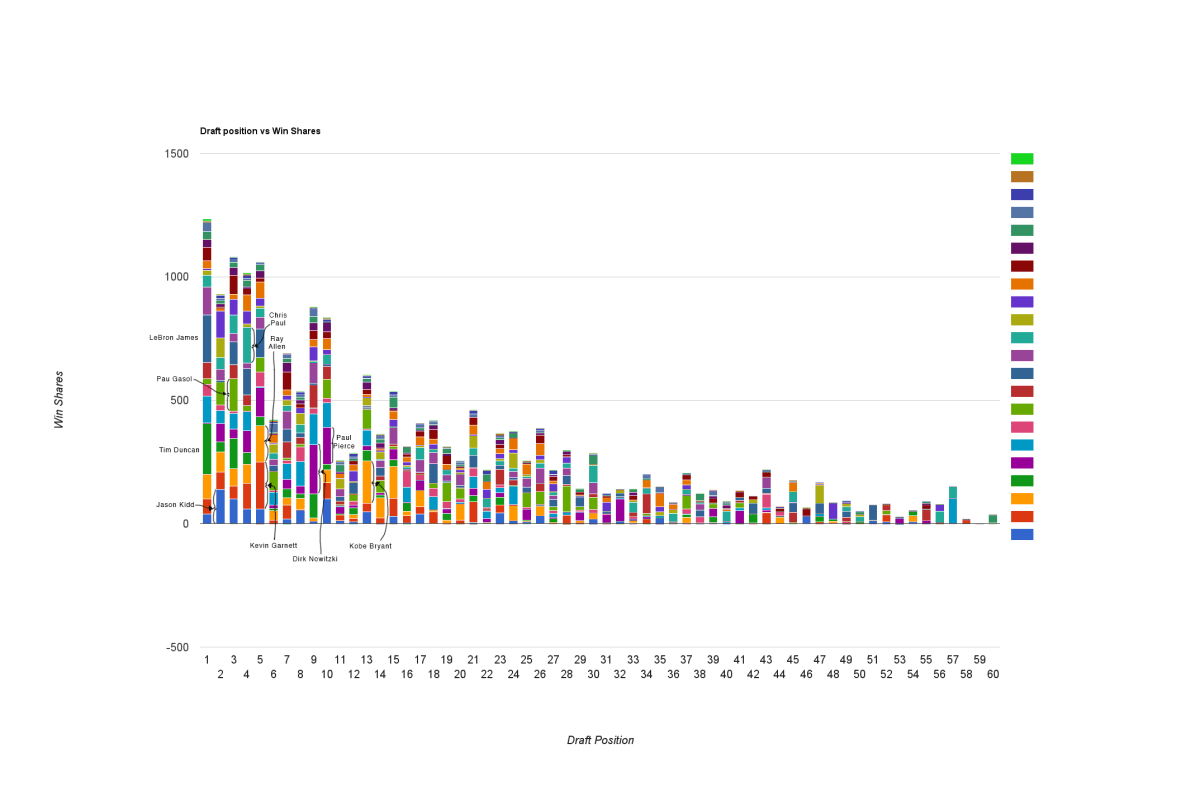
I took the win shares stat for every player drafted since 1994, and slotted them into draft position. I then graphed the total win shares from each draft spot since 1994 and got this:

draftpositionwinshares

Click here for a high quality version of the above graph

Clearly, you can see that the win shares are pushed towards the front of the draft. Highlighting the top 10 win share contributors since 1994 shows that, with the exception of Kobe Bryant, they all went in the first 10 picks. The most important thing to take from this graph is that the advantage of having the number 1 pick isn’t that great, the dropoff from 1 to 5 isn’t great, and neither is it from 1 to 10. The other important thing to learn is that a lot of wins go well after the lottery. You’re by no means missing out of you don’t have a high lottery pick.

Obviously there is a lot of noise in this graph, and another way of looking at this data helps eliminate the bumpiness. This graph takes the cumulative total of win shares taken after a certain pick. Think of it as the amount of win shares already taken if you pick at a certain position.

image (1)

You can clearly see from this graph that a quarter of the wins available in a draft will go within the first 5 picks, and the next quarter will go in picks 6-12. Almost 80% of the wins will be gone by the end of the first round, so about 30% of the win shares are still available to non-lottery teams every draft.

It’s also interesting to look at the median win shares for each pick. Median is the middle score in a set, so this value is useful for eliminating players who far exceed expectations or are complete busts, and is probably a better indicator of the most likely player you would expect to receive from a specific spot.

image (2)

It backs up the observation that you’ll find the best players at the top of the draft, but there’s still some nice players to be found at the end of the lottery and smattered throughout the end of the first round. Interestingly enough, your median 3rd pick will contribute more wins than your median 1st pick. If I were to wager a guess, I’d say that this is because in addition to generational talent being taken at #1, you also get a lot of boom or bust players that eventually bust, think Michael Olowokandi, Kwame Brown, Andrea Bargnani or Greg Oden.

So, what can we learn from the relationship between win shares and draft pick?

– the best players generally go at the top of the draft (it’s comforting to know that NBA GMs aren’t just rolling dice to determine their pick)

– there are plenty of wins to be found outside of the number 1 pick, and still plenty outside of a top 5 pick.

– you won’t find a good player with the 6th pick, ever. Seriously, if anyone can suggest a reason why the 6th pick is so significantly worse than all the surrounding picks, let me know, because it’s so much worse that it almost can’t be chance.

This relationship would suggest that if you can get the number 1 pick, that’s the best place to find a superstar, and settling for the 2-5 pick isn’t a bad substitute either. That being said, there are plenty of players to be found outside of the top 5 picks. So after one relationship, I’d say it’s about 55/45 in favour of tanking. But this relationship is by no means the end of the story.

While this is a good indicator of where the talent comes from in a draft, maybe it’s not the best indicator of championships, because as everyone knows, you need all-stars to win championships, there’s only 5 players on the court so your talent needs to be condensed to win championships. So the logical next step is to look at where championships come from.

PART 2

This is a much harder relationship to investigate than it might initially seem, for a few reasons. First of all, simply finding out how many championships a player has won isn’t as easy as it might seem. It’s not one of the key stats at the top of a player profile, and it’s certainly not a column in a draft summary table. Even if it were easily sourced, that wouldn’t be the most practical way to do things, because not all rings are earned evenly. Purely by championships, Robert Horry is a better player than Dirk Nowitzki, but not a single person who knows how to pronounce Nowitzki would take Horry over Dirk. Therefore, we need a better measure of championships won by a player at a certain draft position.

My solution was to partition each championship into weighted shares based on each player’s contribution to the team that season. The best way to split up players was by win shares, so every player on the roster of a championship team was credited with a championship share. Take LeBron, who had 14.5 win shares in the 2011-12 season, out of the heat’s combined 48.1 win shares. LeBron is credited with 14.5/48.1 championships for that season. This gives most of the credit to the key players on the roster without neglecting role players who are nevertheless essential to a championship team. The timespan was again any player drafted since 1994.

The result of breaking up these championship shares by pick position looks like so:

image (3)

What you get is a more noisy version of the graph we produced by looking at win shares. In one aspect that’s good, because it shows that win shares was probably a good indicator of likelihood to win a championship. But in another aspect, it makes it difficult to try and gain any insight from the data. Let’s start with the bumps. I would say that there are 5 pick positions which can be called bumps in the data. Pick 1, 5, 13, 28 and 57. Pick 1 can be attributed to two players, Tim Duncan and LeBron James, with sprinklings of Glenn Robinson and Andrew Bogut. Pick 5 is a mix of Dwyane Wade, Ray Allen and Kevin Garnett. Pick 13, 28 and 57 can be attributed almost solely to Kobe Bryant, Tony Parker and Manu Ginobili respectively. If we take into account these factors, we can see a similar trend to the previous graph, that a lot of the talent goes at the top of the draft, but there’s still plenty left by the end of the lottery and even an entire half a championship left at the 57th pick.

Looking at the cumulative total tells the same story, where we see roughly half of the championships are taken by halfway through the first round, and the rest is spread out over the following round and a half. Taking a look at the players responsible for the bumps, it needs to be noted that, with the exception of LeBron James, Kevin Garnett and Ray Allen, all of these players were drafted to excellent teams that were already title contenders. The three exceptions all moved to other teams in pursuit of a championship, and earned their chips there.

So the lesson to be learnt from this graph is that nba championships are as much a product of the team you are drafted to as your inherent ability as a basketball player. This would suggest that having a good team environment is essential to growing your talents as a rookie in the NBA. Would Manu Ginobili have created 0.5 championships in his career and won 4 in total were he to have been drafted 1 pick earlier to the Warriors? Almost certainly not, without Pop and Duncan he probably would never have won a title. Would Kobe Bryant have earned an entire championship share and 5 rings in total were he to have not been traded on the day of the trade to the Lakers and instead played for the Hornets? Full respect for Kobe, but probably not without Shaq and Phil Jackson and later Pau Gasol.

So the conclusion from this relationship is that the make-up and quality of the team is critical to a player’s success. This skews the argument heavily in favour of an anti-tanking stance, probably at about 75-25 in favour of not tanking. But this data was based off an admittedly small sample size, there’s another piece of analysis that would be very helpful to evaluate effectiveness of tanking.

PART 3

One way of taking a broader look at the effectiveness of tanking is to stop looking at all of the individual players taken at specific spots, which can be affected by single players who just buck the trend, and instead look at the future success of teams who pick at particular spots. So for the next analytical look at tanking, I charted pick position against the subsequent success of the team for the next 8 years. I chose 8 years because it is a long time, about the length of a player’s first two contracts, and a good length of tenure for a GM to turn around a failing franchise. So take the 1994 draft, where the Bucks picked first. I took their average win percentage for the next 8 years and put that into the number 1 pick data. The next year, the Warriors had the number 1 pick, so I took their win percentage for the next 8 years and added that to the number 1 pick data. After repeating this for every first round pick in the NBA since 1994, I developed a graph of team pick position vs subsequent team success, which looked like so:

image (4)

(aside: I removed the second pick for a team that had multiple first round picks, as I didn’t want the data to be affected by duplication)

The only conclusion that can be drawn from this graph is that it makes almost no difference, the pick positions that perform the worst aren’t that far displaced from the teams that perform the best, excluding some outliers. This is a good sign for the NBA in general, since the point of the draft from a league perspective is to level the playing field, so it’s good that everyone experiences regression to the mean. It’s also worth observing that picking in the middle of the draft, in the so-called no-man’s-land of the NBA, appears to net you a better win% over time than any of the picks further up the draft, with the exception of the number 1 pick.

Additionally, there are no better results than if you can get yourself into a pick right at the end of the draft by being a pretty good team in the first place. So the conclusion here is the better you are, the better your win% will be in the future, unless you can land the #1 pick in the draft. If you tank and don’t get the number 1, you’ll end up in that 2-5 zone which results in the worst records of all picks. However, thanks to the lottery, the odds of getting the number 1 pick if you’re the worst team in the league are only 25%. This more than eliminates the incentive to get the number 1 pick, because it’s not automatic, even if you do suck, and if you win the lottery for second place you’re just stuck in a terrible place anyway.

The good thing about this model is that it isn’t biased by all of the randomness associated with players once they enter the league. This model accounts for the fact that a player might go searching for a new team in free agency, or that they get injured, and account for the fact that to get the number 1 pick, you need to be a bad team to begin with. When factoring in the effectiveness of tanking, you need to consider the fact that if you do land a superstar, they might not want to play for you (see LeBron). And look at the blip at the number 1 pick, it still doesn’t reach above the .500 mark! The only reason that bar is any higher than the ones around it is because of a few guys.

There’s one team that won 70% of their games after the number 1 pick – the spurs (if you’ve got Gregg Popovich as your coach, you can do it. Otherwise, no chance), and only 4 teams that won more that 52% of their games after the number 1 pick. Out of 14 drafts considered, there’s a 4 in 14 chance that you’ll get a player that turns your franchise around. So if you can be so bad that you’re the worst team in the league, you have a 25% chance of getting the number 1 pick (the only one that’s worth getting as can be seen from this graph). And after that, you’ve still only got a 28.6% (4 in 14) chance of that #1 pick being a player that will turn your franchise around. So if you’re the worst team in the league at the end of a given season there’s a 7.1% chance that you’ll become a +.500 team as a result. In other words, don’t bother tanking.

After Part 3, let’s say I’m now fairly in favour of not tanking.

PART 4

Regardless, let’s soldier on further and see if we can dive deeper and gather a defense of tanking! That last relationship still doesn’t truly get to the roots of the issue, because win% is one thing, but the whole point of tanking is to win The Larry O’Brien Trophy, the true mark of a team’s success. (aside: if it means being like the 76ers for 3 years, and being a disgrace to the NBA and compromising the integrity of the league and turning people off being fans of your team, I don’t think it’s worth it to win one trophy, vs being a consistently respectable organisation) So let’s see if we can go one step further and instead look at the subsequent championships after picking at a certain pick. Luckily for me, it only took subbing in the championship winner each year to my spreadsheet instead of wins to get me that data. So let’s have a look at exactly the same process but chips instead of wins.

image (5)

That’s pretty depressing for anyone with the number 1 pick, let’s be honest. Oh and by the way, if you’re still saying “but it’s still be best of a lot of inefficient strategies” if I take away 1 draft, the 1997 draft that saw Tim Duncan go to the Spurs, there is not a single team that has turned a number 1 pick into a championship in the 8 years following their selection. None. So tanking: not looking good.

Okay, this sample size isn’t huge, there have only been about 20 championships in this whole time frame, so let’s see if we can pad all the numbers up a little bit, flesh things out. Conference titles. Everyone agrees if you make it to the dance you’re in with a good shot.

image (6)

Well, that hasn’t helped the case of the number 1 pick at all. Again, if you take out Tim Duncan, that line goes down some more and it’s almost no better than the next few picks all after it. So the case for the number 1 pick being a boom or bust strategy that could land you a championship is in a shambles.

CONCLUSION

So, after looking at all of those independent pieces of data and formulating a conclusion, I’ll enunciate them here. It’s pretty clear that tanking has worked once, the 1997 draft to select Tim Duncan. One time. Other times, it’s been effective at picking up stars, like LeBron James. But still no championships. So in the last 20 years, tanking has worked once, and you know why it worked? Because a humble, low-ego, super-talented player entered the league onto the roster of one of the best coaches in NBA history, put his head down and learnt and practiced and grew into one of the best power forwards of all time. He also landed on a roster that had some really good pieces and a former number 1 pick already there.

When the spurs got Duncan, it was a 1 time deal, they were bad for a single year thanks to injuries, lucked into Duncan and never looked back. So what we can learn from the one time tanking worked is not that tanking works, but instead that if you’re one of the best coaches in NBA history, you can make it work. But what of players like Kobe Bryant, Paul Pierce, Kevin Garnett? Well it’s pretty clear that the reason they were successful is because of a smart GM who saw their talent and landed an absolute gem later in the draft. We saw it work with the Spurs twice, when they drafted Tony Parker and Manu Ginobili with the 28th and 57th picks respectively in their own draft classes. Kobe and Pierce were also drafted to historically good franchises, and Garnett won his titles with one of those historic franchises.

I think the biggest flaw in thinking for those who expound tanking is a big assumption about the talent coming out of a draft. They assume that LeBron was a board-eating, dime-dropping, muscle-machine MVP when he was drafted, but in fact it took him years to develop the skills to be the player he is today. What he was, was a hard worker and hyper-dedicated. Duncan wasn’t drafted as one of the most skillful, graceful post players of all time. He was a hard worker, and extremely humble. See the same for every other transcendental talent, they got where they are because of hard work that continued into the NBA. If Duncan were to be drafted to the Sixers in this year’s draft as the lanky 21 year old he was in 1997 – without the help of David Robinson and Gregg Popovich – he wouldn’t win 5 titles. Straight up, he wouldn’t. Coaches and GMs win Championships. Let me phrase that another way, good teams win Championships. Good teams don’t lose on purpose. Don’t lose on purpose. Don’t tank.

  • You can look at the spreadsheets I used for this data here
  • Statistics were sourced from Basketball-Reference
  • An Article by Jack Neubecker