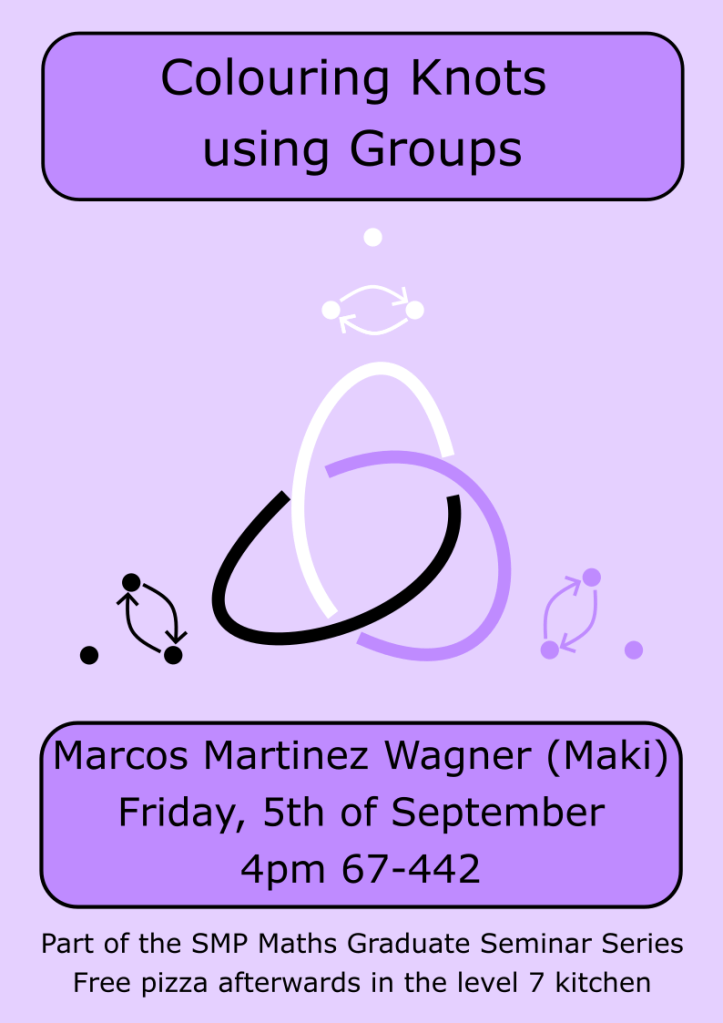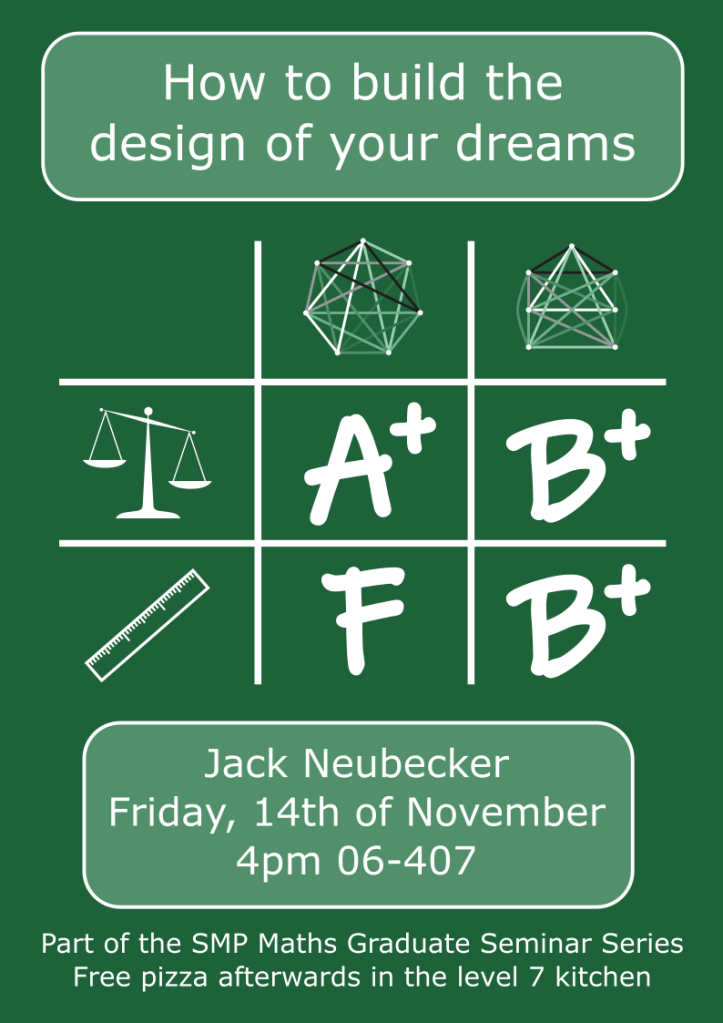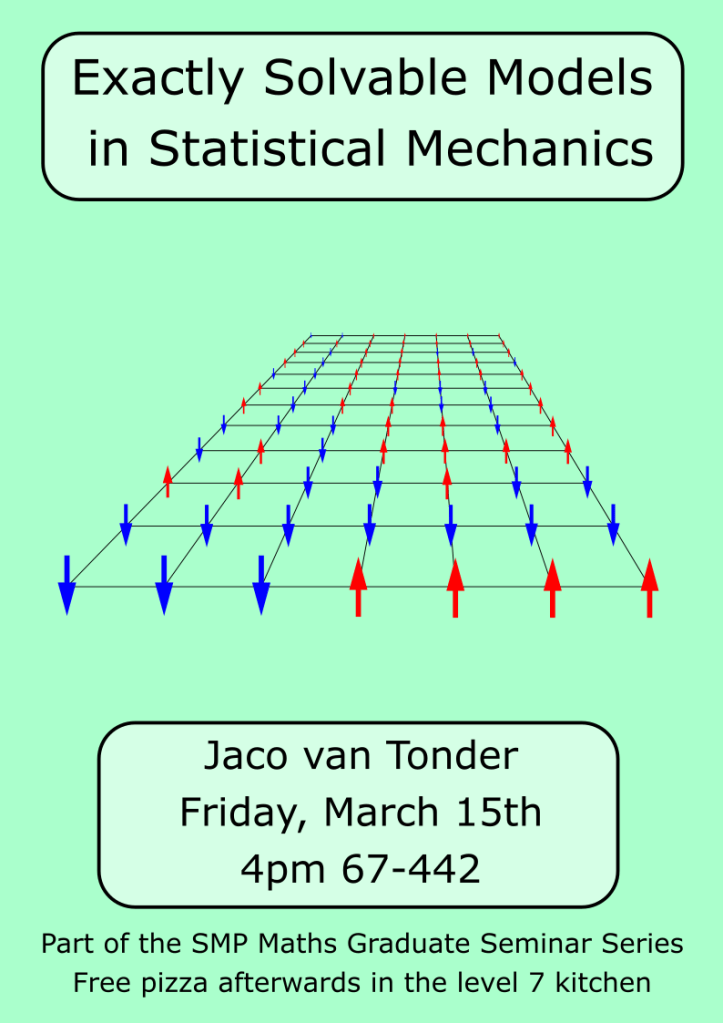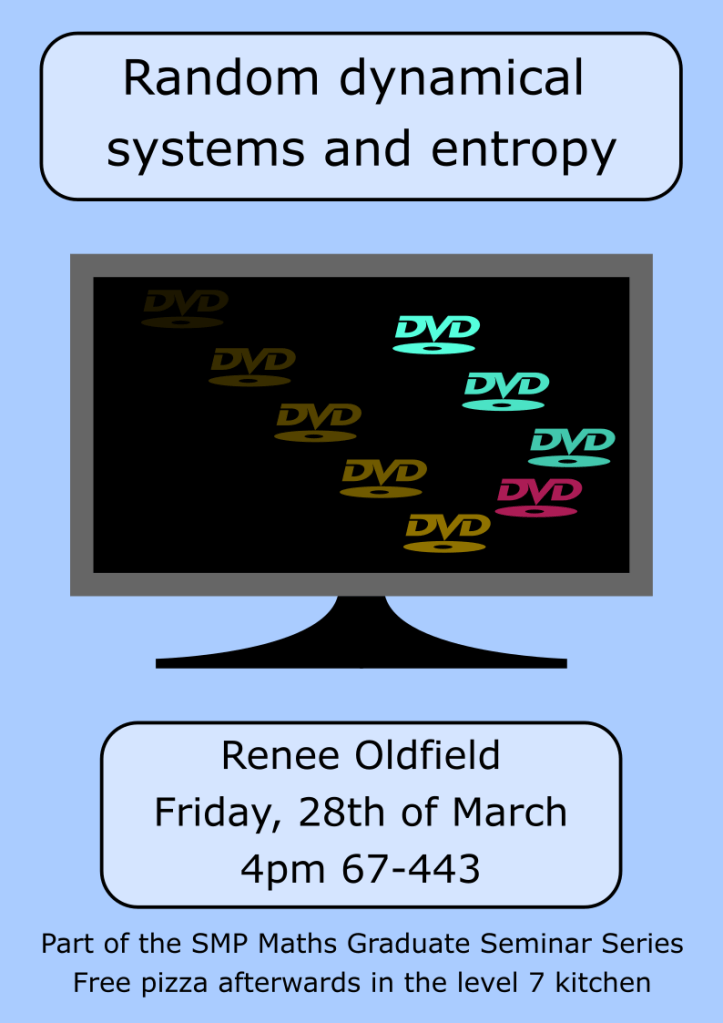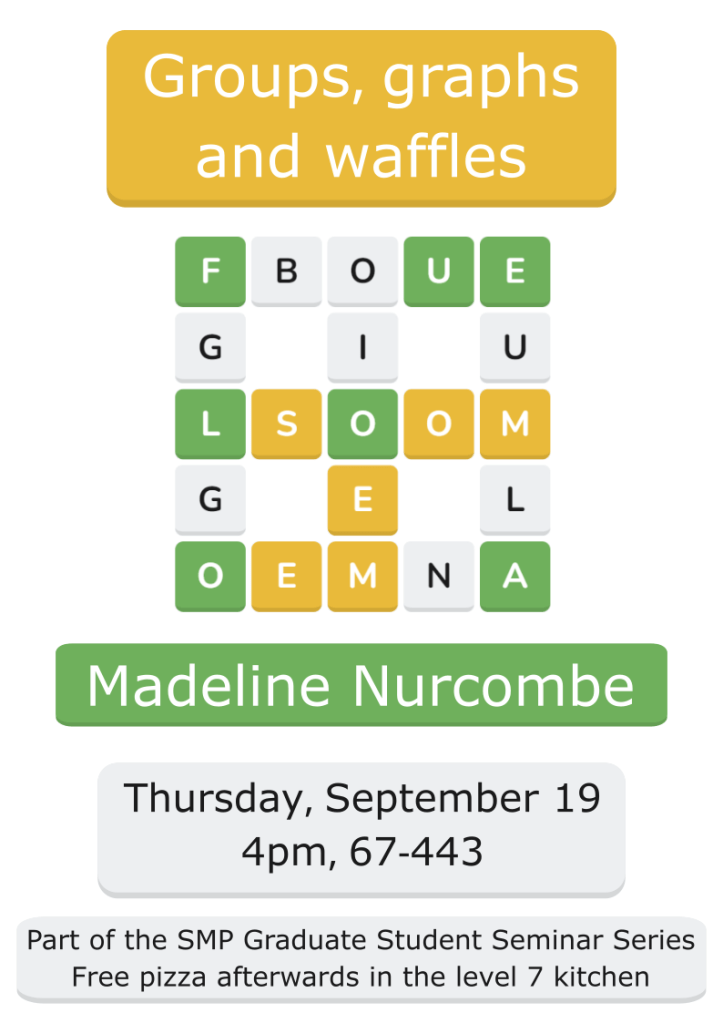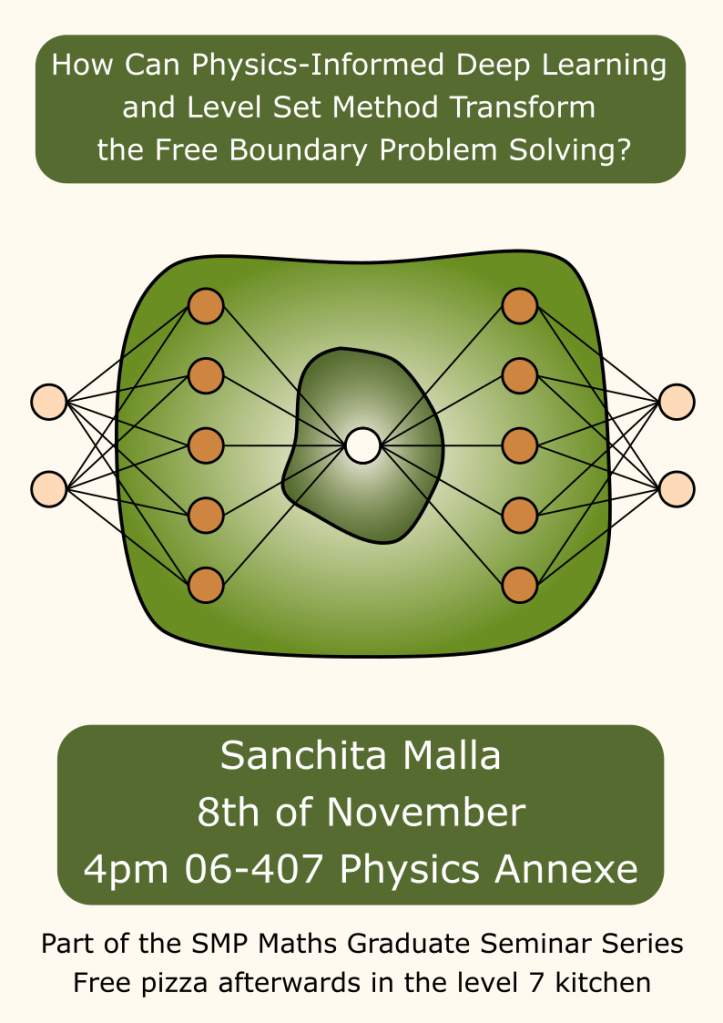
SMP Maths Graduate Seminar Series Posters: Semester 2 2025

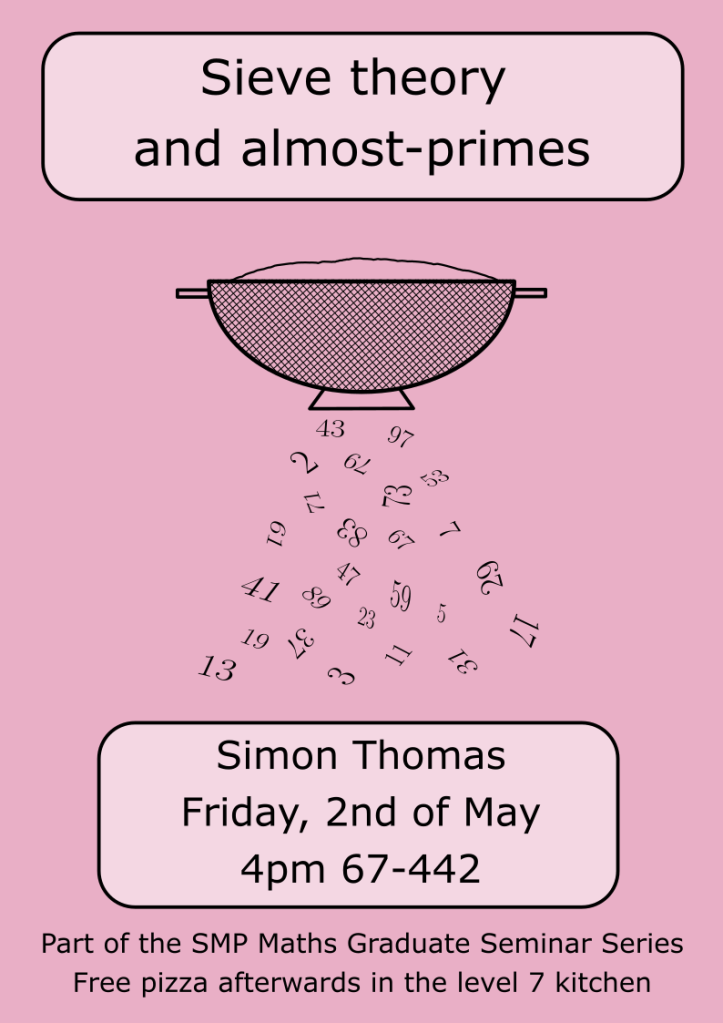
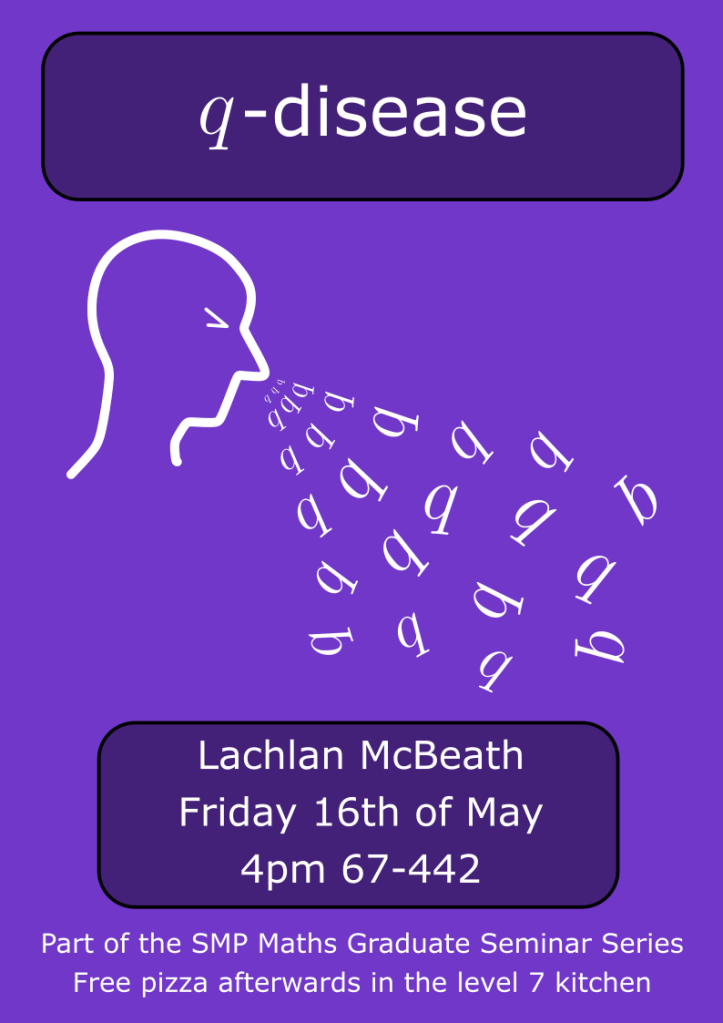
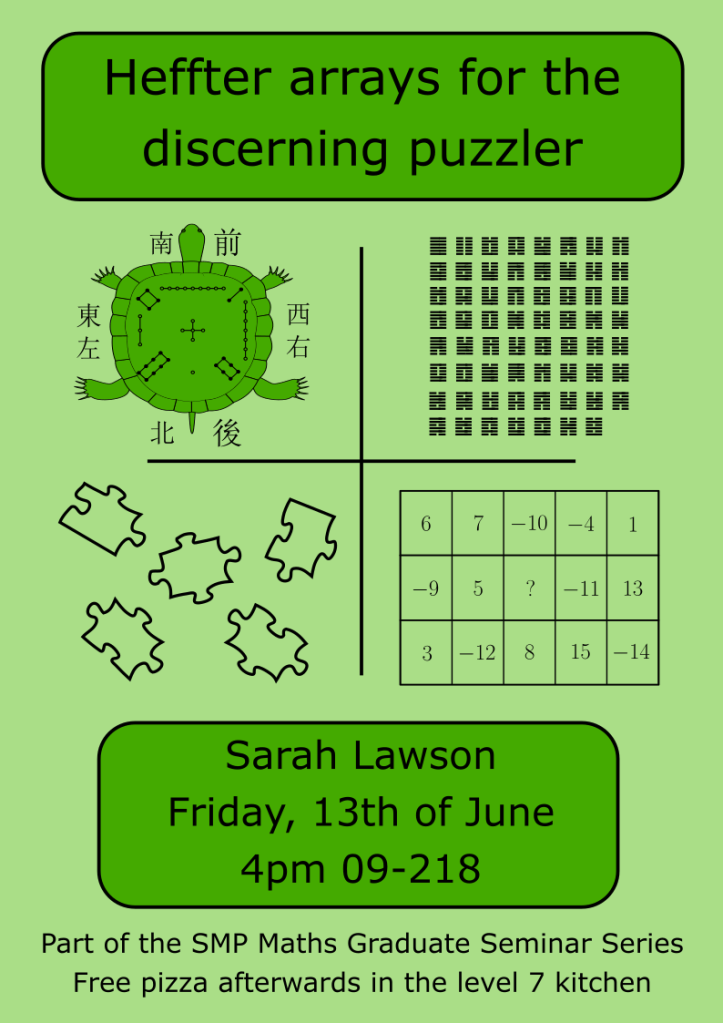
This is part III in a series of posts documenting the posters I’ve made for the SMP Maths Graduate Seminar Series. Check out part I and part II.

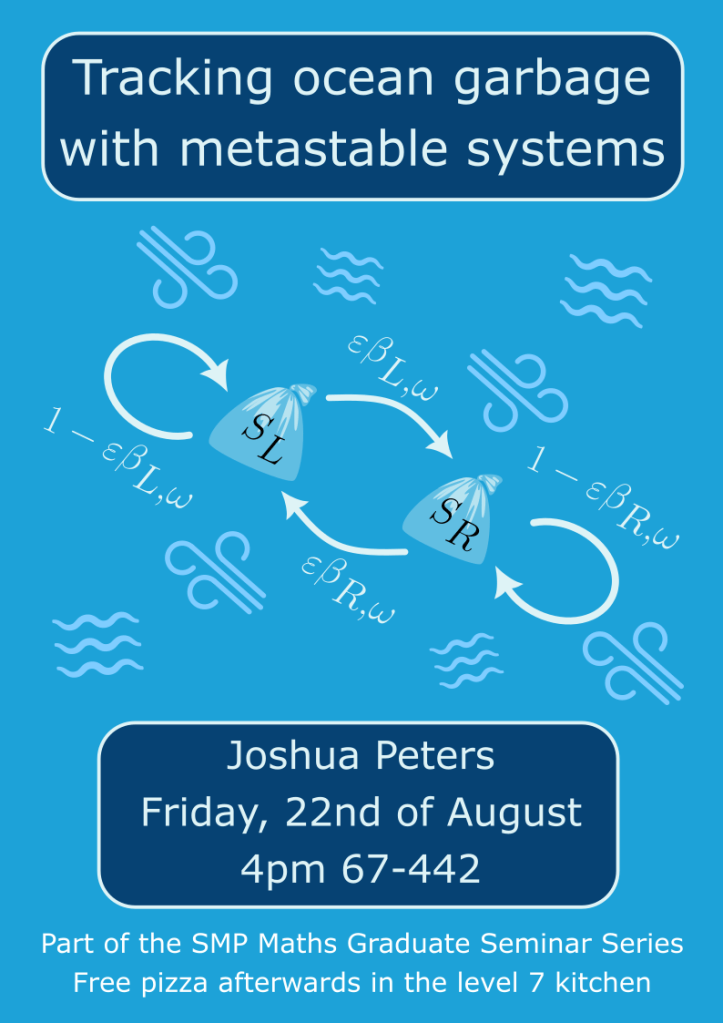
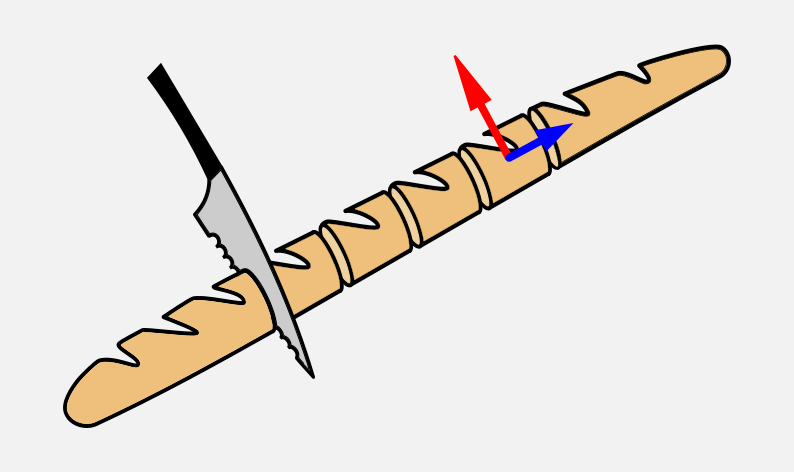
It is surprisingly hard to make a poster for your own talk. Familiarity breeds contempt?

Creative Commons attributions

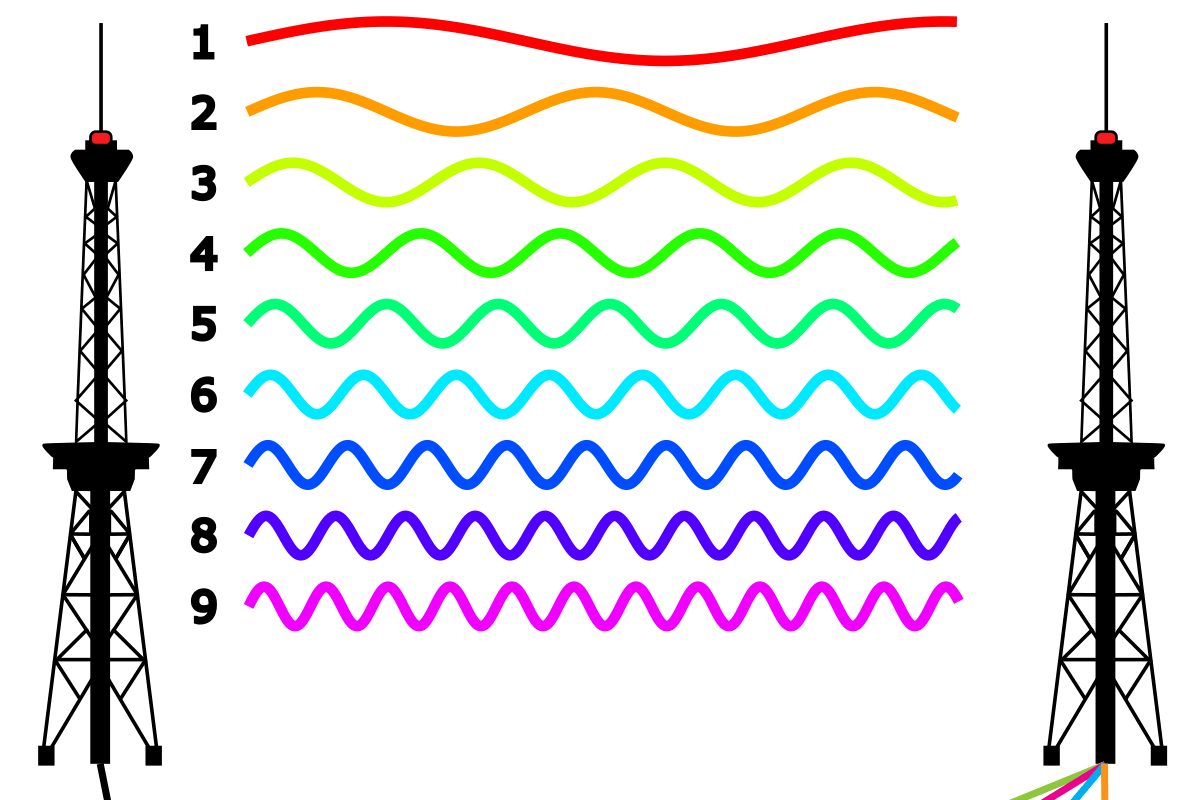
As ever, I’m indebted to those who make their work freely available for use and modification on the Wikimedia Commons.

Colour palettes

SMP Maths Graduate Seminar Series Posters: Semester 1 2025

This is part II in a series of posts documenting the posters I’ve made for the SMP Maths Graduate Seminar Series. Check out part I here.

You may be able to tell that an increased degree of skill has to be taken together with an increase degree of ambition.

Creative Commons attributions

As ever, I’m indebted to those who make their work freely available for use and modification on the Wikimedia Commons.

Why somebody uploaded a green turtle in tergiant posture with red claws to the Wikimedia Commons is beyond me, but I’m glad they did!

A letter to my parents’ friends

I recently learned that my parents have been carrying around an A4 printout of this poster in an attempt to help explain to curious acquaintances what it is I actually do as a research mathematician. This is quite a nice thing to do, but the reader may immediately recognise this as a gross mismatch of intended and actual audience.

The challenge this presents is clear — to create an audience-appropriate, pamphlet-sized, self-contained explanation of my work. This of course shares a lot with the more familiar elevator pitch, with a couple of key differences. The main additional challenge is that, unlike over a pint at the pub, the narrator is unable to adapt to their audience. One must anticipate and address as many questions as possible in a fixed amount of space, and cannot lean on the specific expertise of the reader. On the other hand, a print-out can immediately call upon a carefully constructed and tailor-made diagram, whereas at least one of these criteria must usually be abandoned in impromptu settings. I encourage you to attempt your own version of this exercise, it’s rather entertaining and informative.

Here is my present attempt. I’m sure it will remain in a state of perpetual beta testing, so don’t hesitate to provide feedback if you so desire.

SMP Maths Graduate Seminar Series Posters: Semester 2 2024

I’ve been part of the organising committee for the SMP Maths Graduate Seminar Series since the start of the semester. During a boots-on-the-ground door-knocking campaign, we realised that a few posters put up around the place would really boost our attendance. The main purpose is to reach the eyeballs of our colleagues who are less inclined to checking their emails, but of course it also imbues the series with a greater sense of professionalism. I’ve been in charge of poster design, and I’m proud of the work, so I’m going to share the results here.

Well, I’m not going to apply for any graphic design jobs any time soon! But I reckon it’s alright for a mathematician. You can see a rough template and theme developing over the semester. All the posters are produced with Inkscape, which I’ve had a real fondness for ever since Rhuaidi Burke recommended it to me earlier this year.

I can’t take credit for every element of creativity — I’m indebted to Wikimedia commons for some of the more complex graphics for which I lacked either the time or skills to create myself. I’m getting better and would like to expand my diagram production skills, and building off the work of those more competent than me is a great way to do that. I’m going to include the graphics I’ve used here so that you can infer by omission the work that is mine 🙂

I ‘m going to try to figure out how to make a diagram like the geodesic above, watch this space!