One of the most exciting and hotly debated topics at every NFL Draft is the trading of picks. Teams will make these trades for many reasons: moving up before the draft starts to get a Quarterback i.e. The Rams and Eagles, or jumping ahead a few picks to ensure that the apple of the GM’s eye doesn’t get taken just before their selection. For this reason, understanding the value of a certain pick number could really benefit a decision maker for an NFL team, and help take away the bias in every GM’s head that they are intrinsically better at picking than everyone else. This article will use similar methods to my article analysing the benefits of tanking in the NBA, but will instead focus on the value of a particular pick than whether or not the top picks lead to winning. Fair warning seeing as this is a basketball site: This is about the NFL. You have been warned.
The first thing that needs to be done when quantifying the value of historical picks is determining what metric should be used for evaluating players. Using yards or touchdowns would work for only skill-position players and tackles might work for defensive players, but we’d have no way of comparing between positions, and stats for offensive linemen are almost non-existent. Career earnings might be an effective measuring stick but this is already skewed by scaled rookie contracts and has no way of accounting for a player who fails to live up to their second contract. Pro-bowls and All-Pro selections might work, but these don’t tell the whole story, as a player can be greatly valuable to their team without earning any pro-bowl selections. Luckily, pro-football-reference has thought about this problem before, and devised their own method for measuring the career value of players called Approximate Value (AV). You can read about how it’s developed here. It properly accounts for many factors that end up with an accurate assessment of a player’s value.
Click here to view interactive versions of all of the tables which follow, as well as access the source data or download the workbook yourself.
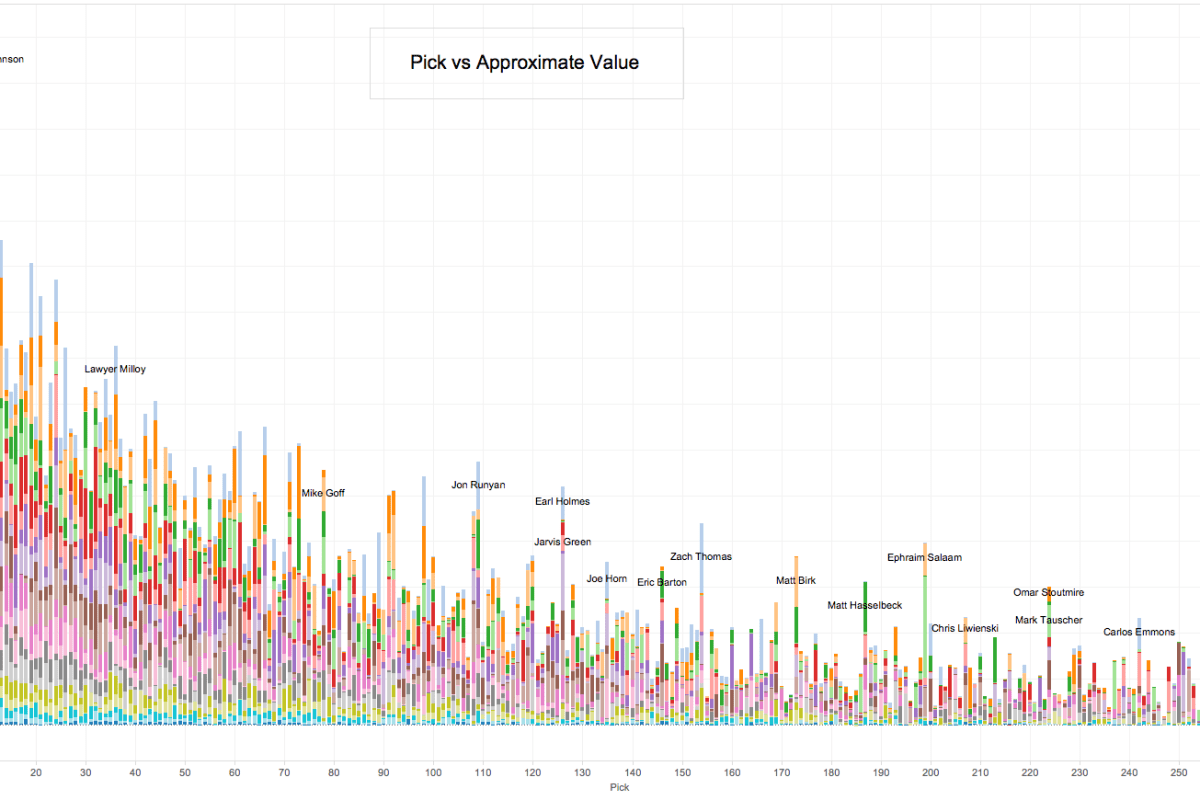
The first and most simple relationship to look at is Approximate Value vs Pick position. The following graph will contextualise the availability of talent over the course of the draft, with every player drafted since 1996 being used as the sample size for this investigation.

It’s clear that the best players mostly go at the top of the draft, which is a good thing. We also see the number 1 pick adding the most value, which is a reasonable result, seeing as it’s the best pick to find a home-run hall-of-fame talent. We can also see that there are a lot of excellent players that get drafted deep into the final day of the draft, stories which most of us have probably heard about. However, there isn’t a great deal that can be taken from this graph because it is an absolute mess. We can’t simply attribute the value of each pick to its average AV, because it would be ignorant to say that the 199th pick is more valuable than the 80th pick because of a few lucky players including Tom Brady. We need some way of removing the outliers and looking at the sort of player you can expect to draft at a particular position.
The best way to do this is to instead look at the median AV for each pick position. This removes the outliers which are busts and steals. It also provides a great measure for the expected AV from a particular pick because 50% of historical picks were better than the median, and 50% were worse.

We now see that we have a much less noisy graph from which we can gather some more information. Obviously there is still a lot of noise, as we have a fairly bumpy line, but with a simple trend line which has been plotted in grey, we have developed a formula which estimates the expected AV of a particular pick. A polynomial formula was chosen as it provided the best fit with the relatively high value of early picks and the steadily decreasing value of late round picks, finally tapering off to 0 with the so-called irrelevant picks at the end of the draft. The formula is of the n^3 type and is a bit messy, but looks like this:
Approximate Pick Value = -6.60394e-06*Pick^3 + 0.00362413*Pick^2 + -0.670325*Pick + 45.424
We also need to develop an estimate for the value of future draft picks, because we don’t know where a team’s pick will fall until the conclusion of the next season. By simply taking the median AV for all players selected in a particular round, we can get a fair approximation for the value of future picks. The main weakness of this calculation is that it includes supplementary picks at the end of particular rounds, which are not included in future trades, which would slightly negatively affect the value of particular rounds. But the effect is almost negligible due to the randomness of all picks.

We see a similar shape to the pick-by-pick graph, so we know this is a reasonable graph. From here we are able to reasonably approximate the value gained or lost for some of the biggest trades in the 2016 draft.
The two that are most meaty to analyse are the trades made by the Rams and the Eagles to move up to the top of the draft to select Jared Goff and Carson Wentz. in the Goff trade that was completed first, the Rams received: 2016 – #1, #113, #177, and the Titans received: 2016 – #15, #43, #45, #76 and 2017 – 1st round, 3rd round.
| Rams Receive: | Pick Value |
| 2016, #1 | 44.75729252606 |
| 2016, #113 | 6.42498575582 |
| 2016, #177 | 3.69645775198001 |
| Total Value | 54.87873603386 |
| Titans Receive: | Pick Value |
| 2016, #15 | 36.1622659525 |
| 2016, #43 | 22.77598191242 |
| 2016, #45 | 21.9964542175 |
| 2016, #76 | 12.51330371456 |
| 2017, Round 1 | 36 |
| 2017, Round 3 | 10 |
| Total Value | 139.44800579698 |
So one can conclude that the Rams sacrificed 139.45 points of value to the Titans in return for 54.88 points of value. Now that’s not to say that the Rams strictly lost 85 points of value, all of this is entirely dependent on the specific situation a team is facing with regards to their roster. From the Ram’s point of view, they already have a pretty stacked roster everywhere outside of the Quarterback, so for them, adding a bunch of players at positions that they already have would suggest those players are less likely to add a lot of value to the Rams. Additionally, they’re expected to add 44.8 points of value with one player, their rookie quarterback, which is exactly the hole in the roster they need filled. So from the Rams perspective, it might be worth it to sacrifice 140 points of AV in return for 44.8 points of AV at one spot in the roster that needs filling. From the Titan’s perspective, however, this is an absolute slam dunk. Gaining a net 85 points of AV is a huge haul, which could turn into some very valuable players.
Let’s look at the other big trade of the offseason, the Eagles trading up with the Browns to select Carson Wentz.
| Eagles Receive: | Pick Value |
|
2016, #2 |
44.09779368848 |
|
2017, Round 4 |
7 |
| Total Value |
51.09779368848 |
| Browns Receive: | value |
|
2016, #8 |
40.28996310272 |
|
2016, #77 |
12.28152522998 |
|
2016, #100 |
8.02886 |
|
2017, Round 1 |
36 |
|
2018, Round 2 |
21 |
| Total Value |
117.6003483327 |
This trade isn’t as lopsided as the trade for the number 1 pick, which isn’t a big surprise considering the perceived greater value of the number 1 pick. However, it’s a considerable haul for the browns who have the opportunity to add 3 players with +20 AV. There’s plenty of picks which could be analysed, including countless draft-day trades where teams move up a couple of spots, most of which are not that interesting. For that reason, I created a spreadsheet that quickly calculates the AV traded in a particular swap of draft picks, which can be found here. Simply download your own version to edit the highlighted input areas and see how your team fared on draft day when it came to trades.
My analysis to this point has simply been on the amount of expected total value added or lost in a particular trade, but this somewhat misses the essence of trading draft picks for half of the league. While total AV is a great measure for teams looking to improve their entire roster like the Titans or Browns, it overlooks the desires of a team aiming to move up in the draft like the Eagles or Rams. For them, they’re more interested in trading a lot of players with reasonable AV for one player to fill one spot on the roster with as much AV as possible. For this reason, I thought it necessary to add another element of analysis to the calculus for trading picks.
While simply looking at which team got the pick with the highest estimated AV might provide some clarity here, it doesn’t tell the full story. It might be that a team moves up for the number 1 pick but in turn gives up a couple of picks which, combined, give a better chance at picking up a Pro-Bowl calibre player. The way to properly investigate this is to take the distribution of players which can be taken with a certain pick, by measuring the standard deviation of AV taken at a certain pick. Then, one can calculate the odds that a particular pick will result in a player with AV greater than a certain amount, say 60 AV (which is roughly the minimum value for an All-Pro player). Then, by taking the probability for all of the traded picks, one can quite easily calculate the odds that one of the picks turns into a +60AV player. Using this calculation, one can take another look at the two biggest trades analysed earlier and see if it more accurately reflects what the Eagles and Rams were aiming to gain from the trade.
In the Rams/Titans trade for the number 1 pick, it was pretty clear that the Titans pulled off an absolute heist when it came to total AV, which was their goal, as they need to put as much talent as possible around Marcus Mariota moving forward. But if we look at the odds of either team earning themselves a pro-bowl talent, the story changes slightly.
| AV | Titans | Rams |
| total | 139.4480058 | 57.2120127 |
| 40 | 0.7681549095 | 0.5579975043 |
| 50 | 0.5086942213 | 0.4446985388 |
| 60 | 0.3091670338 | 0.3405035364 |
| 70 | 0.1912181388 | 0.2478980144 |
| 80 | 0.1198511853 | 0.170811554 |
| 90 | 0.07298295843 | 0.1110815966 |
| >100 | 0.04217354009 | 0.06802947466 |
We see that when it comes to gaining a player with AV greater than 40 or 50, the titans are still in front, which is expected, as these are scores for quality starters, the type of players the Titans were looking to add. But for earning a player with AV greater than 60, the ledger swings in favour of the Rams, who have increased their chances of finding themselves an All-Pro level talent at Quarterback. So it would seem that both the Rams and Titans have achieved their goal with the trade.
Now let’s look at the Carson Wentz trade, and see if we see a similar result with the Eagles.
| AV | Eagles | Browns |
| total | 51.09779369 | 117.6003483 |
| 40 | 0.5838220646 | 0.8030838151 |
| 50 | 0.421429454 | 0.579078266 |
| 60 | 0.2770324051 | 0.3653103498 |
| 70 | 0.1645533065 | 0.218933875 |
| 80 | 0.08754859688 | 0.1308536876 |
| 90 | 0.04140852509 | 0.0769407191 |
| >100 | 0.01731490997 | 0.04345448672 |
Bad news for Eagles fans, your team got fleeced in the trade. Not only do the Browns pick up more total AV than the Eagles, but they also happen to have a higher chance of their picks turning into a difference maker. This demonstrates the reason why the Browns would be willing to gain less total AV from the trade, compared with the number 1 pick, because they seem to be aware of the fact that they’re gaining more picks that could be difference makers in the NFL. Aside: Normally with results like this I assume that the decision makers had their own reasons and opinions that happen to coincide with an analytical view-point, but given that the Browns have hired Paul DePodesta as Chief Strategy Officer, pioneer of moneyball in the MLB, I have a sneaky feeling that the Browns’ decision makers were looking at almost exactly the same numbers as I have here when deciding to accept the Eagles’ trade offer. Most likely they had a differing strategy to valuing picks than AV, but it no doubt would have yielded similar results.
There were dozens of other trades that went down on draft day that are worth looking, but it’s not worth putting them all in this article, so I encourage readers to play around with the spreadsheet here and see how the numbers shape up with the analysts’ opinions on the trades. There are a lot of unique situations to play around with, like teams moving up a couple of spots which has mixed results. Overall it appears to be that the negotiation skills of GMs can have a great swing on how much value a team earns in the trading process, as well as teams that are in the fortunate position of not needing to make blockbuster deals to stay competitive, i.e. the Packers, Steelers, Patriots or Cardinals. Overall, this tool should serve as one more method for evaluating the success of the trading of picks. Additionally, if any GMs are reading this, feel free to use the model to your advantage.
- An Article By Jack Neubecker
- Read about a similar article on tanking in the NBA
- Read about how AV was developed here
- Click here for interactive versions of the graphs used or to download the data
- Use the interactive Spreadsheet to experiment with other trades
- Statistics sourced from pro-football-reference


 Jack Neubecker
You must be logged in to post a comment.