
My hope is that this post distills the interesting unanswered questions from my honours thesis. The final question relies on various results and definitions which I will try to introduce in the most interesting way possible, occasionally avoiding formalism if it conflicts with reader enjoyment and intuition. I will try and title broad sections so those already familiar can skip if they want to rush ahead. I will assume you are already familiar or able to look up basic graph theory notations and definitions. If ever you crave more of the gruesome details, they are of course to be found in the thesis.
Hamilton decomposition of a finite graph

Here we see 
The natural question for a given graph is whether or not it has a Hamilton decomposition. The obvious criteria are that the graph must be connected, and even-regular. The less obvious necessary condition is a refinement of the connected condition; more precisely, a 

Exercise: Prove this necessary condition.
A graph which fits the necessary criteria will be called admissible. If every admissible graph had a Hamilton decomposition, then we would be done, but we know of examples where this is not the case, even if we assume a high level of structure in the graph. In general it is still hard to tell if an admissible graph has a Hamilton decomposition, but there are some lovely families of admissible graphs for which we do know a Hamilton decomposition.
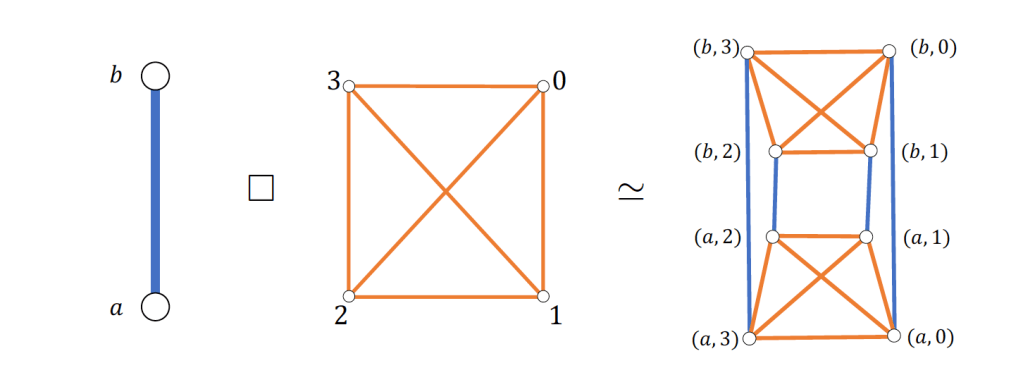
One family of graphs for which we know a lot is the Cartesian product 


Exercises: Check that 


Exercise: (for those who are familiar with graph automorphisms) Verify that 
Of relevance for us are the following results:

Kotzig 1973 [1]: The Cartesian product of two cycles 
Foregger 1978 [1]: The Cartesian product of three cycles 
Aubert and Schneider 1982 []: If 
There are stronger results, culminating with Stong (1991) [3], but these results are enough for us to forge ahead towards our final problem.
Hamilton decomposition of an infinite graph
We borrow the interpretation of a Hamilton cycle in a finite graph as a spanning 2-regular subgraph. This no longer forms a cycle then, as such a cycle would only visit a finite number of vertices, it instead forms a path. We call such a path in an infinite graph a Hamilton double-ray. Then a Hamilton decomposition of an infinite graph is a colouring of the edges so that every colour is a Hamilton double-ray. We will denote by 

 -distance graph, which has the integers as vertices, and an edge between two vertices
  iff
iff  .
. 
Observe in the above two examples some lovely properties. In the distance graph, we have the same chunk of colouring repeated every 6 units, a clever exploitation of the sliding symmetry of the integers. Similarly in the lattice, each colour is self-symmetric under a 180º-rotation, and the two colours are each a 90º-rotation of the other, cleverly exploiting the rotational symmetry of the lattice. I find this to be such a simple and lovely picture, I can’t believe this would be a 21st century observation. Like the six-petal rosette, it should have been noticed countless times throughout history, perhaps a Girih in a Syrian shrine, or painted onto an ancient roman pot. Art historians please get in touch. Otherwise, we should pin down a key difference in the structure of these two infinite graphs.

Ends of infinite graphs
Informally, we can think of an end of a graph as a distinct direction into which our graph can extend infinitely. Slightly less informally, we say two ends are different if there is some finite vertex-deletion which makes the two ends disconnected. Then we can say that the number of ends of a graph is the maximum number of infinite connected components under some finite vertex-deletion. Then any finite graph has 0 ends. What are other possible values for the number of ends of a graph? The distance graph has 2, deleting a reasonably large chuck of vertices in the middle will produce two infinite connected components, one on the left (a negative end) and one on the right (a positive end). It might seem at first that the lattice has many, corresponding to different angles of escape, but in fact it only has 1. Any finite deletion of vertices might leave some finite components in the middle, but will never leave two infinite connected components. A graph can certainly have more than 2: taking the 
Extra necessary conditions
Unfortunately, there is another obstacle which arises when we begin to consider such infinite graphs. As well as requiring no more than 2 ends, if the graph is one-ended, there may be a parity issue as to why no decomposition can exist. Consider the following two-ended graph 
 .
. Note the three dotted edges. Each Hamilton double-ray must pass through this edge-set an odd number of times, as otherwise it would have both its ends on the same side of the graph, which in turn would mean it only visits a finite number of vertices on the other side. As this graph is 4-regular, it would be decomposed into two Hamilton double-rays. Two odds add to an even, but there are 3 edges, so clearly this is not possible. This argument can be generalised and refined in the case where our two-ended graph is of the form 


 .
. The big questions
Erde, Lehner and Pitz 2020 [4]: If
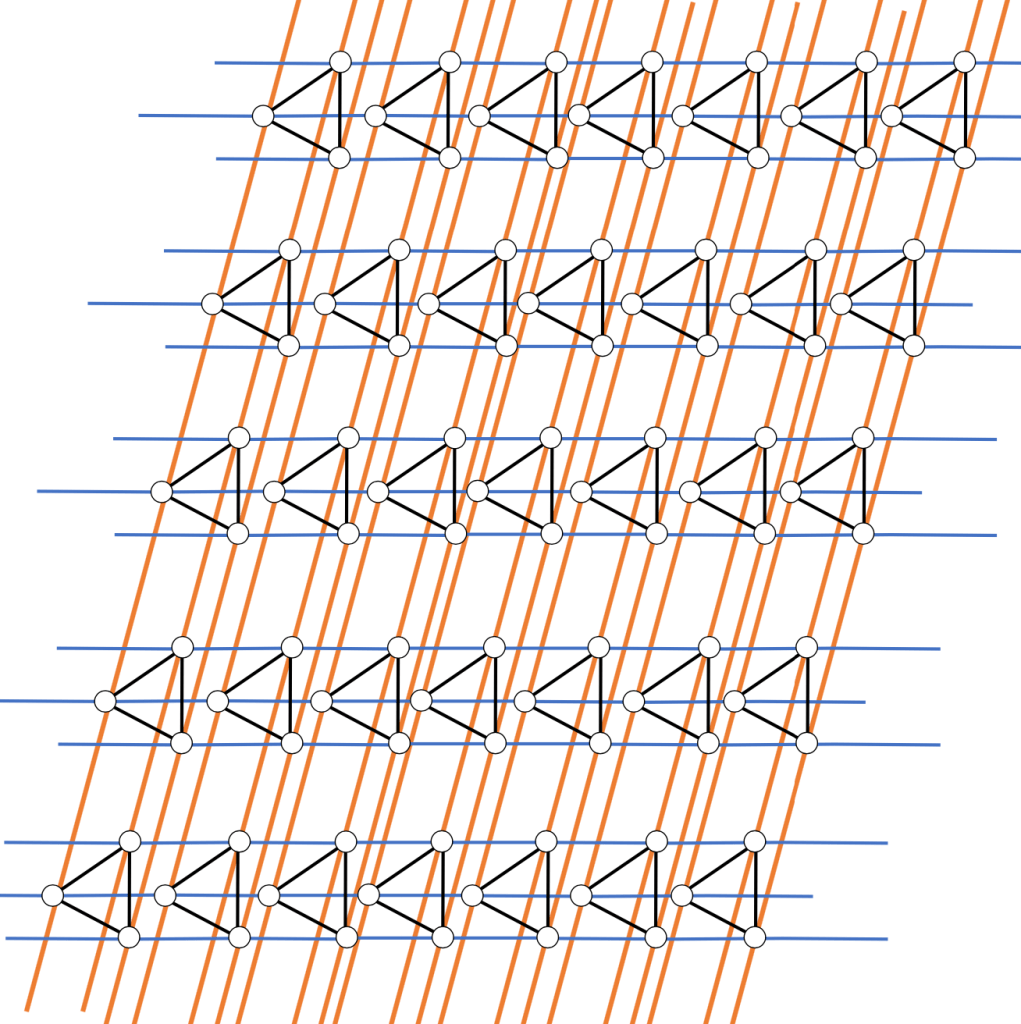
 .
. In general, it would be nice if 


Bibliography
[1] Marsha F. Foregger. Hamiltonian decompositions of products of cycles. Discrete Mathematics, 24:251–260, 1978.
[2] Jacques Aubert and Bernadette Schneider. Decomposition de la somme cartesienne d’un cycle et de l’union de deux cycles hamiltoniens en cycles hamiltoniens. Discrete Mathematics, 38:7–16, 1982.
[3] Richard Stong. Hamilton decompositions of Cartesian products of graphs. Discrete Mathematics, 90:169–190, 1991.
[4] Joshua Erde, Florian Lehner, and Max Pitz. Hamilton decompositions of one-ended Cayley graphs.
Journal of Combinatorial Theory, B(140):171–191, 2020.

 is a graph with vertex set the elements of the group
  , and edge set
  . A Hamilton cycle is a closed path which visits every vertex in a graph exactly once, and a Hamilton decomposition of a graph is a partition of its edge-set into Hamilton cycles. It has been conjectured by Alspach that every connected
  is Hamilton decomposable. Bermond also conjectures that if two graphs are Hamilton decomposable, then their Cartesian product is also Hamilton decomposable. These three conjectures remain open, and we examine their infinite generalisations. Specifically, we study two-ended infinite abelian groups, and the Cartesian product
  , where
  is a two-way infinite path. The notion of a Hamilton cycle can be generalised to infinite graphs as a spanning two-way infinite path. However, if the graph has two ends, some graphs contain an end-separating edge-cut which differs in parity from the number of paths in the decomposition, precluding the existence of a decomposition into spanning two-way infinite paths. The question, then, is whether this is the only obstruction to a Hamilton decomposition.
We show that if
is a two-way infinite path. The notion of a Hamilton cycle can be generalised to infinite graphs as a spanning two-way infinite path. However, if the graph has two ends, some graphs contain an end-separating edge-cut which differs in parity from the number of paths in the decomposition, precluding the existence of a decomposition into spanning two-way infinite paths. The question, then, is whether this is the only obstruction to a Hamilton decomposition.
We show that if  Jack Neubecker
You must be logged in to post a comment.